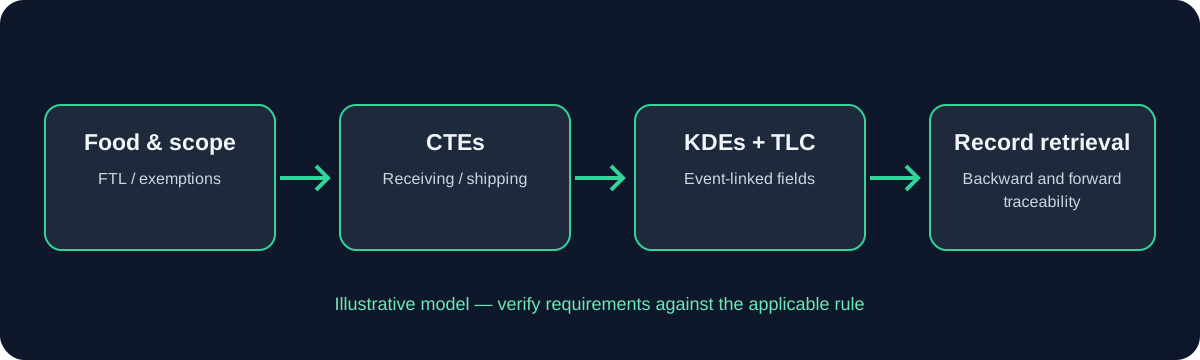
What this guide covers
Record the product and form, ingredient composition, processing and storage state, supply-chain role, and actual activities. Compare with the FTL and identify CTEs that may apply.
Practical implementation
Use the form below to note your product, role, FTL review, and exemption review. Save the rationale and source in your internal scope file, then map applicable KDEs, TLC processes, plan elements, and record retrieval.
Limitations and verification
The form cannot determine legal coverage. If product facts, definitions, or exemption conditions are unclear, mark the result unresolved and seek qualified review.
Preliminary scope worksheet
Use these fields to organize your review. This form does not determine legal coverage.
Record the facts, source provision, and decision rationale in your internal scope file.
Stage one: establish whether the food is on the FTL
An applicability assessment should not begin and end with “we are a small business” or “our customer handles compliance.” Start with the food: identify the product and its form, compare it with the current FTL description, and assess any relevant listed-food-as-ingredient issue. Then map the activities the entity performs and evaluate each potentially applicable CTE. Finally, review the exact exemption or exception provisions against the actual facts.
Stage two: map the business activity and exemptions
Gather product specifications, ingredient statements, process-flow diagrams, supplier details, facility role, destination and transaction records. For each decision, note what evidence was reviewed and which facts remain uncertain. If a business handles several food categories, assess them separately rather than making one facility-wide conclusion that may not fit every product.
Record a conclusion that can be revisited
Example: a distributor receives a product that may fall within an FTL category and then stores and ships it. The assessment should separately document the product-scope conclusion, the receiving and shipping activities, any exemption analysis, and how the required data are obtained and passed onward. If the distributor begins repacking or processing, reopen the event map rather than relying on the original storage-only analysis.
The output should be a short signed decision record with product scope, activity map, cited provisions, supporting evidence, conclusion, limitations, reviewer and review trigger. This is a structured educational process, not an automated legal determination. Obtain qualified advice when product form, exemptions or event definitions are uncertain.
Practical verification points
- Record the applicable food, activity and rule provision.
- Assign an owner, source record and exception path.
- Retest the workflow after material changes and retain evidence.
A decision record that survives an audit or staff change
The written outcome should identify the product and its exact form, the business activities reviewed, the rule provisions considered, exemptions or exceptions evaluated, supporting documents and the conclusion. Include the date and reviewer, and state any unresolved assumption. Avoid recording only “covered” or “not covered” because that label does not explain what facts support it.
For a business with multiple facilities, determine whether each facility performs the same activities and handles the same products. A central product register can be shared, but facility-specific events, record locations and third-party arrangements may differ. Do not let a conclusion for one warehouse automatically apply to a separate processing facility.
Review the decision when the product, supplier, process, destination or regulatory source changes. If the conclusion depends on a disputed interpretation, ask a qualified regulatory professional to review the facts and cited provision.
How to verify this information
Official and supporting sources
Verify important regulatory claims against primary sources. Draft guidance is non-binding.
Educational information only. The regulation and current official guidance control. This page is not legal advice, FDA approval, or a guarantee of compliance.