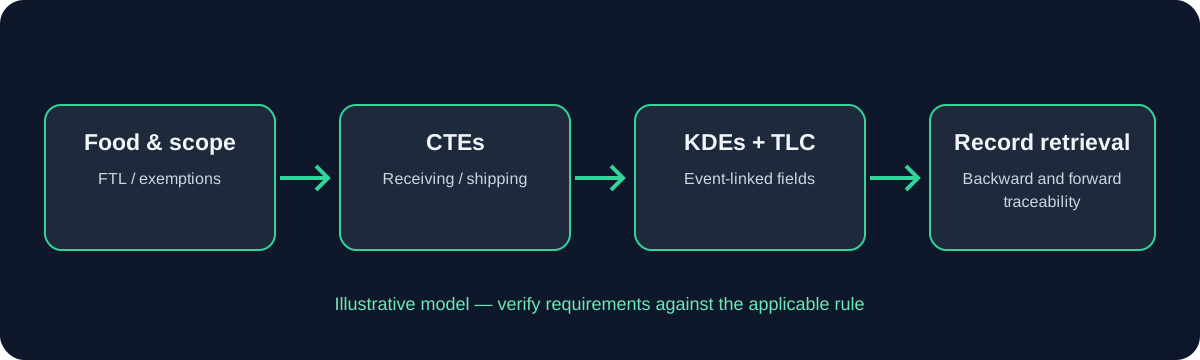
What this guide covers
Scope and farm records: Compare commodity, form, ingredients, and process state with the exact FTL entry. Where applicable, map fields/growing areas, harvest records, location descriptions, lot identifiers, and initial packing records.
Practical implementation
Supply-chain handoffs: Produce may move through farms, cooling, packing, consolidation, distribution, and retail. Define how lot identity and required information move between partners, including partial shipments and returned product.
Limitations and verification
Practical verification: Test a sample lot backward and forward. Confirm dates, quantities, locations, TLC details, source information, and applicable exemptions.
Keep growing-area identity and packing-lot identity connected
Fresh produce operations may include growing, harvesting, cooling, initial packing, storage and shipment. The Food Traceability Rule does not treat all those activities as one generic “produce record”; applicability and KDEs depend on the covered food and the event performed. Use the FTL description to classify the actual commodity and form, then map each relevant operation to the rule.
Coordinate farm, cooling and packing records
Growing-area names and identifiers must be understandable across the people who create the farm map, harvest records and packing records. If a field is known internally by a nickname but the controlled map uses a different name, define the mapping and train the team. Changes to field boundaries, names or mapping conventions should trigger a controlled update so historic records remain interpretable.
Use change control for mixed lots and repacking
For a realistic example, consider produce harvested from two areas and moved to a cooling step before initial packing. The procedure should explain how the business preserves the origin relationships and which lot identity is used at each stage. Do not assume that all harvested material can be combined without affecting traceability; document the actual aggregation decision and confirm the resulting records still support the required trace.
Before a season begins, verify field/location master data, label readability, backup record forms, supplier/customer data exchange and access to records when connectivity is poor. Sample records during the season rather than waiting for an annual audit. Product scope and exact event fields must be confirmed against the current regulation and FDA sources.
Practical verification points
- Document who assigns and controls the identifier.
- Preserve links between internal identifiers and the traceability lot.
- Test split, correction and transformation scenarios where applicable.
Season-start verification checklist
Before harvest begins, verify the current product-scope register, growing-area map, field identifiers, record forms, label supplies, staff training and handoff to cooling or packing. Confirm that backup paper records can be reconciled to the digital system and that the original evidence remains legible.
Choose one product and trace it through the expected seasonal process. Include a field change or split lot if that occurs in the operation. Record which steps worked, which identifiers required manual translation and whether the final export retained the origin relationship.
After a major field, supplier, packing-line or system change, update the process map and retrain affected staff. The most useful review is performed close to the change, while the details are still observable.
Coordination between farm, packer and distributor
Agree which identifier accompanies the product at each handoff and how the receiving party will recognise it. If a farm uses a harvest identifier and a packer uses a packing-lot identifier, the procedure should explain how the relationship is recorded and which identifier is used for the applicable event. A handoff should not depend on a verbal explanation from the driver or field supervisor.
Before the season, exchange sample records with the packer and distributor. Verify that the data are understandable, the lot references match the product labels and the records can be reconciled to the actual transaction. Repeat the test after a label or system change.
When product is held, split or repacked, update the traceability record according to the actual event and applicable requirements. Do not allow a new internal pallet or order number to sever the connection to the relevant lot.
Example: a lot is split between two packing runs
If harvested product is split across two packing runs, the procedure should preserve which source material went to each resulting lot. The business should not assume that both outputs share the same traceability identity unless the actual lot definition and applicable rule support that treatment. Record the split using the identifiers available at the time and make the relationship retrievable.
Test the forward trace from the source to both packing outcomes and the backward trace from each packed lot to the relevant source records. Check that the farm map and harvest record use identifiers that can be resolved by packing staff and by the person assembling the trace.
If the current system cannot represent the split clearly, define a controlled interim method and prioritise a permanent data-link solution. Keep the exception visible until the fix is tested.
How to verify this information
Official and supporting sources
Verify important regulatory claims against primary sources. Draft guidance is non-binding.
Educational information only. The regulation and current official guidance control. This page is not legal advice, FDA approval, or a guarantee of compliance.