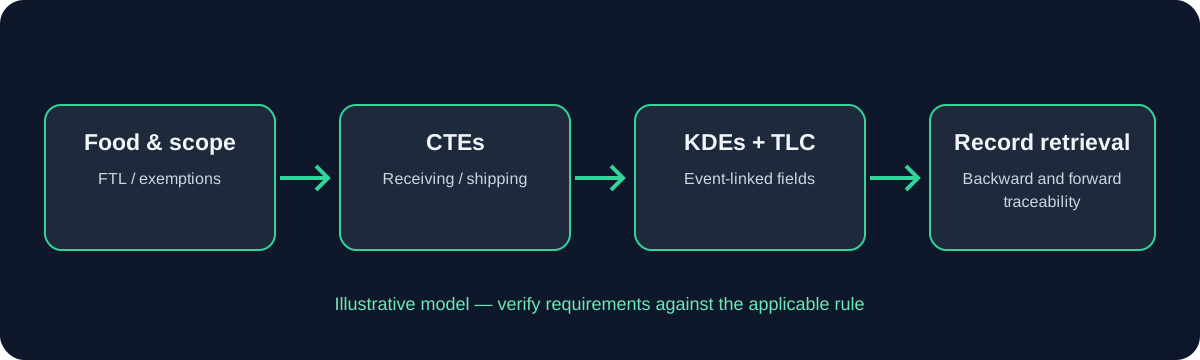
What this guide covers
Scope and exemption questions: Identify whether the operation manufactures, processes, packs, or holds listed food and which activities are relevant. Monitor official FDA updates on retail and restaurant flexibilities; draft policies are not blanket exemptions.
Practical implementation
Practical records and handoffs: Where the rule applies, map receiving, shipping, lot identification, supplier documents, storage identification, and record retrieval across shifts. If food is combined or repacked, review whether scope or event mapping changes.
Limitations and verification
Practical verification: Test whether staff can identify a potentially covered product and retrieve relevant records. Do not make a legal decision from a news summary or retailer status alone.
Distinguish receiving records from downstream handling
Retail and foodservice operations require careful analysis because the rule includes specific provisions and exceptions for certain activities and entities. Do not assume every retail transaction creates the same record obligations, and do not assume that every restaurant or retail establishment is exempt from every relevant requirement. Use the exact rule text and current FDA guidance for the facts at hand.
Review applicable exceptions rather than assuming blanket coverage
Inventory and point-of-sale systems may be designed around product codes and sales units rather than traceability lot relationships. Where records are required, define how a received lot is associated with the item or preparation process and how the business retrieves the relevant source record. Avoid promising a customer that a receipt or menu item alone constitutes the complete traceability record.
Prepare an operationally realistic trace procedure
For operations that portion, prepare, combine or otherwise handle covered food, map the actual activity and determine whether the regulatory definition of transformation or another event applies. Do not assume a kitchen step is or is not transformation without reviewing the specific rule and facts. Keep scope decisions separate from food-safety procedures such as allergen, sanitation or temperature controls.
Test a practical incident scenario during a busy shift. Can the designated person locate the supplier and lot information, identify affected product still on site, preserve the records and contact the right person? Include backup access for evenings and weekends. Check the current FDA retail/restaurant guidance, noting whether a document is draft and non-binding.
Practical verification points
- Record the applicable food, activity and rule provision.
- Assign an owner, source record and exception path.
- Retest the workflow after material changes and retain evidence.
A practical shift-level trace drill
Choose a covered product handled by the location and ask the designated shift lead to locate the relevant receiving record, identify the product/lot currently on hand if applicable, and find the internal contact responsible for traceability. Document what the person can do without assistance and where the procedure is unclear.
Include after-hours coverage and turnover. A process that only works when one manager is present is fragile. Keep instructions short enough for staff to use under operating pressure, and keep the detailed regulatory rationale in the controlled procedure or training material.
Confirm the applicability and any retail/restaurant-specific provisions using current FDA materials. If relying on draft guidance, label it as draft and do not describe its recommendations as binding requirements.
Make records usable during a real incident
Keep the procedure short, visible and role-specific. The shift lead should know the first step, the location of the relevant records and the contact who can retrieve more detailed information. A detailed manual is useful only if staff can find the required section under time pressure.
If the operation relies on invoices, delivery records or supplier portals, verify which of those sources actually contains the identifiers required for the relevant event. Do not assume a product description or sales receipt alone identifies the traceability lot.
Use the exact current FDA provisions to determine which retail or restaurant exceptions apply. Because draft guidance can change and is non-binding, label it clearly and do not convert proposed flexibility into a universal rule.
Example: receiving data are not immediately available
If a delivery arrives before its full documentation, use a documented exception process that identifies the product and transaction, records what information is missing and names the person responsible for follow-up. Do not treat the receipt as fully reconciled solely because the product was physically accepted.
When the missing data arrive, verify the lot identifier and source information and link the record to the receipt. Preserve the original delivery evidence and any correction. The process should work on evenings and weekends when the usual manager may not be available.
Confirm the actual legal requirements and applicable retail/restaurant provisions using current official material; do not infer a universal exemption from the business label alone.
How to verify this information
Official and supporting sources
Verify important regulatory claims against primary sources. Draft guidance is non-binding.
Educational information only. The regulation and current official guidance control. This page is not legal advice, FDA approval, or a guarantee of compliance.