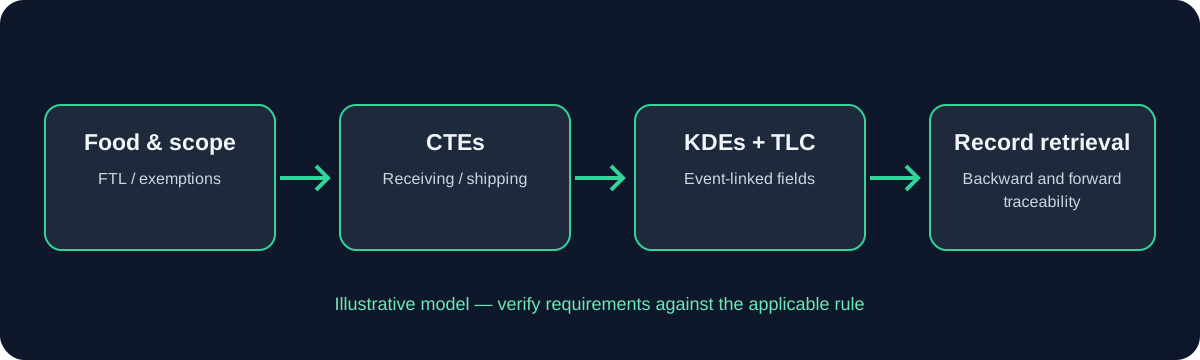
What this guide covers
An exemption may depend on food, activity, entity, transaction, or other conditions. Some provisions exempt an entity from all or part of a requirement. A single business can have several product flows and different outcomes.
Practical implementation
Record product/form, activity, parties, facts, applicable provision, evidence, date checked, reviewer, and any limitations. Keep unresolved issues open for qualified review and reassess after a meaningful change.
Limitations and verification
Do not infer exemption simply from small size, retail status, farm status, seafood handling, or a processing step. Read the FTL and exact exemption provision together.
Separate person-based, food-based and activity-specific analysis
An exemption should never be recorded as a simple yes/no based only on company size, product category or a customer’s assurance. The rule contains different exemption and exception provisions, each with its own conditions. The relevant facts may include the type of entity, the food, the activity, the destination, the source of the food, or the conditions under which a transaction occurs. Read the exact current provision and any applicable FDA explanation before making the determination.
Build a defensible exemption file
Use a decision record that identifies the provision considered, the facts required by that provision, the evidence supporting each fact, the conclusion, any limitations and the person who approved it. If a provision requires a particular statement, record or transaction condition, preserve that evidence. Do not generalise a narrow exception into a site-wide exemption: the same company may conduct different activities or handle different products with different outcomes.
Review triggers and escalation
For supplier-provided exemption claims, request the rationale and supporting information relevant to the exact product and transaction. Confirm whether the claim is current and whether your own downstream activity creates separate obligations. If the exemption affects traceability-lot-code assignment or records received from an exempt entity, evaluate the specific rule language rather than assuming no further action is required.
Review the determination after a material change: a new product, new ingredient, change in processing, different supplier, new customer channel, acquisition, change in facility role or revised regulation/guidance. Ambiguous cases should be escalated to a qualified regulatory professional. This educational page is a decision aid, not an individual legal determination.
Practical verification points
- Cite the exact provision and retain evidence for each condition.
- Separate the entity-level decision from product- and transaction-specific facts.
- Assign a reviewer and a change trigger; do not treat an old conclusion as permanent.
Evidence matrix for an exemption decision
An exemption file is stronger when it lists each condition separately rather than attaching a single supplier declaration. For each condition, record the rule citation, the factual question, the evidence reviewed, the conclusion and any limit on the conclusion. If the provision depends on a sales threshold, relationship, product form, transaction or type of entity, retain the evidence needed to establish that condition and the period it covers.
An exemption can be misunderstood when teams copy a decision from one product or customer to another. Keep the scope of the decision explicit: legal entity, facility, product, activity and transaction as relevant. If the business operates more than one facility or handles products through different routes, make sure the record does not imply a broader exemption than the evidence supports.
When evidence is incomplete, do not guess. Record what is missing and seek regulatory review. The cost of a documented unresolved question is usually easier to manage than a confident conclusion with no factual basis.
Avoid three common exemption-analysis traps
First, do not use business size as a universal exemption. A size-based provision may have a defined calculation, time period and conditions; other provisions may apply for different reasons. Second, do not assume an exemption for one activity applies to every activity at the same facility. Third, do not assume an upstream party’s exemption automatically settles the receiving entity’s obligations for the food or transaction.
When a rule provision requires an entity to maintain or provide particular information despite another party’s status, follow that specific text. This is especially important when a covered food is received from an entity that is exempt from some requirements and the receiving entity must determine whether a TLC or other record action is needed. Do not generalise from one example to all exemptions.
An exemption decision should be reviewed by someone with appropriate regulatory competence when it determines whether a required event or identifier is captured. Retain the source, facts and approval so the business can explain the decision to a new reviewer after personnel or systems change.
How to document uncertainty and review decisions
Not every question can be resolved from a product name or a short supplier email. Where the facts are incomplete, mark the assessment as pending and list the evidence required to close it. Avoid recording a definitive exemption while waiting for a missing specification, sales record or transaction detail that is material to the provision.
When a reviewer reaches a conclusion, preserve the reasoning and any assumptions. State whether the conclusion applies to a named product, facility, activity or time period. If facts later change, the record should make clear why the old decision must be reassessed rather than reused automatically.
Use specialist review for ambiguous legal interpretation. A template can structure the evidence, but it cannot resolve a contested interpretation or guarantee that a regulator will accept the conclusion.
Example: an exemption claim received from a supplier
When a supplier states that it is exempt, ask which provision it relies on and which facts support that conclusion. Identify whether the claim applies to the supplier as an entity, a particular food, an activity or a transaction. Review whether the receiving business has separate duties under the rule and whether the circumstances require any specific action when the food is received.
If the supplier provides only a general certificate, mark the evidence gap and request clarification. Do not translate “supplier exempt” into “no traceability data needed” without analysing the exact provision. Where the conclusion affects required recordkeeping or TLC handling, obtain qualified review if the rule’s application is uncertain.
Keep the supplier’s claim, supporting evidence, internal assessment and final decision together. Recheck the decision if the product, supplier facility, activity or transaction changes.
How to verify this information
Official and supporting sources
Verify important regulatory claims against primary sources. Draft guidance is non-binding.
Educational information only. The regulation and current official guidance control. This page is not legal advice, FDA approval, or a guarantee of compliance.