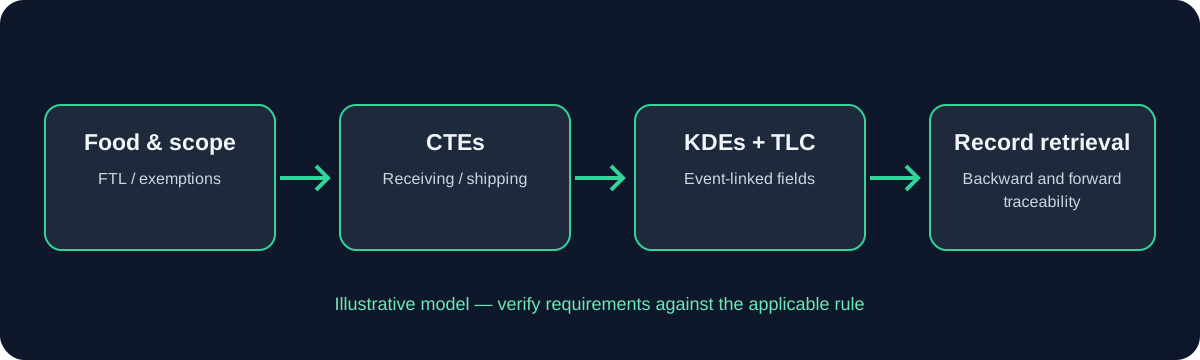
What this guide covers
The rule adds records for certain foods identified on the FTL. It aims to help identify where covered food moved and connect relevant events during a potential food-safety investigation. The rule is codified in 21 CFR Part 1, Subpart S; it does not require every business to use one specific software brand.
Practical implementation
Inventory products and activities; verify FTL status and exemptions; map applicable CTEs to KDEs and source records; check TLC assignment and source information; review the traceability plan; test supplier/customer exchanges and retrieval.
Limitations and verification
Coverage is not determined by job title or broad industry category. The exact food, product form, activity, and exemption conditions matter. Treat templates as educational aids and verify each legal conclusion against the current regulation.
Start with the food and activity, not the software
FSMA section 204(d) led to the FDA Food Traceability Rule in 21 CFR Part 1, Subpart S. It adds records for specified foods and supply-chain activities; it does not replace every other food-safety obligation. The central question is whether a person manufactures, processes, packs or holds food on the Food Traceability List (FTL), whether an exemption or exception applies, and which listed Critical Tracking Events (CTEs) the person performs.
Worked example: tracing a lot across three firms
A useful scope review has four separate decisions: identify the exact food and its form; check the FTL description and any qualifying ingredient rule; map the company’s actual activities to the regulatory event definitions; and test whether a specific exemption applies to the person, food or transaction. Record the basis for each decision. A supplier’s statement that a product is “not covered” is evidence to evaluate, not a substitute for your own documented assessment.
Implementation evidence that demonstrates control
Imagine a covered fresh product moves from a grower to a packer and then to a distributor. The grower’s harvest record, the packer’s initial-packing record and the distributor’s receiving and shipping records are not interchangeable. The lot code and related data must remain connected as the product moves. If a business transforms the food, the analysis changes because the records must preserve the relationship between relevant inputs and outputs under the applicable provisions.
A strong implementation file contains a product-scope register, a process map, event-to-KDE matrices, traceability-lot-code procedures, a written traceability plan where required, supplier/customer data-exchange rules, record-retention controls and a tested FDA-response export. These artifacts should agree with one another. A plan that names a system but does not explain how a user retrieves the records is incomplete as an operational control.
Practical verification points
- Record the applicable food, activity and rule provision.
- Assign an owner, source record and exception path.
- Retest the workflow after material changes and retain evidence.
End-to-end example: what a trace should reveal
Consider a distributor that receives a covered food, stores it for two days and ships portions of the lot to three customers. A useful trace begins with one selected customer shipment and identifies the shipping record, the traceability lot, the corresponding receiving record and the supplier/source information linked to that lot. The forward trace begins with the source lot and identifies all relevant downstream movements. The goal is not merely to collect documents; it is to reconstruct the movement of the selected food from linked records.
The exercise should also expose boundary questions. If the distributor only stores and ships the food, its event map may differ from a facility that repacks or transforms it. If a supplier’s internal batch number differs from the TLC, the mapping between them must be available and understandable. If an exemption is claimed, the supporting decision should be retrievable with the same product and transaction facts used in the trace.
Use a trace pack containing the scope decision, event map, sample KDE matrix, TLC assignment procedure where relevant, traceability plan, source documents and an example sortable export. Keep a short index showing where each record lives. A reviewer should be able to follow the chain without searching multiple drives or asking the original operator to explain undocumented conventions.
How to govern the programme after initial setup
Assign a programme owner who can coordinate regulatory review, operations, supplier management, quality, IT and customer service. The owner should maintain the scope register, event map, requirements matrix, training plan, testing calendar and change log. Each record should have a named operational owner; a central coordinator cannot compensate for a process where nobody is accountable for entering or validating data at the time the event occurs.
Use risk-based review intervals. Review high-impact product scope and event mappings after any change to the product, process, supplier, facility role or system. Review routine records through sampling and review the full traceability response process through mock exercises. The review schedule should be documented and should not be represented as an FDA-mandated frequency unless the regulation specifically says so.
Keep a short management dashboard that shows unresolved scope questions, suppliers with untested data exchanges, failed record-quality checks, open corrective actions and the date of the last successful trace. These are internal performance indicators, not proof of compliance on their own. Their value is to show where the system needs attention before an incident reveals the gap.
What a defensible implementation file looks like
Keep the programme evidence organised so the business can answer four questions quickly: why is this food in or out of scope; which events does this operation perform; where are the required records and identifiers; and can the information be assembled and explained from the source records? A compact index can link to the scope register, process map, KDE matrix, traceability plan, supplier exchange specifications, test reports and corrective actions.
The index should not become a second, manually maintained source of truth. Link to controlled documents and assign an owner to verify that each link works. If a source file is superseded, preserve the historical version where needed and make the current version obvious. During a mock trace, note whether the reviewer can find the evidence without asking the document owner for directions.
Use lessons from tests to revise the system, not only the training deck. If the same issue appears across several lots, investigate the shared cause—field definitions, interface mapping, responsibility, supplier data or document control—and verify that the corrective action improves later records.
How to verify this information
Official and supporting sources
Verify important regulatory claims against primary sources. Draft guidance is non-binding.
Educational information only. The regulation and current official guidance control. This page is not legal advice, FDA approval, or a guarantee of compliance.