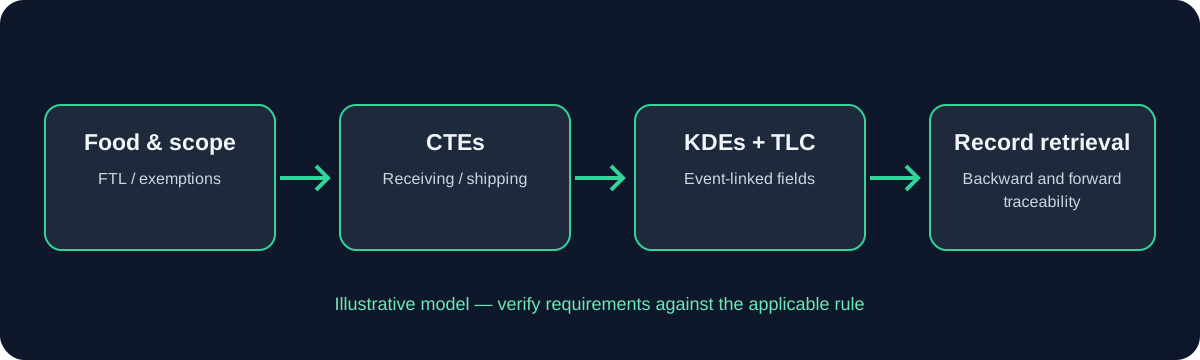
What this guide covers
Map product/lot, quantities, dates, locations, partners, and other KDEs required by the relevant shipping or receiving provision.
Practical implementation
Reconcile purchase orders, receiving logs, bills of lading, invoices, and inventory systems. Test partial shipments, split lots, returns, and discrepancies.
Limitations and verification
The planning examples are not a complete legal field list; cite the exact provision.
Reconcile the transaction across both trading partners
Shipping and receiving are distinct CTEs with event-specific KDEs. A seller’s shipping record and a buyer’s receiving record describe different sides of a movement; they should be reconcilable, but they need not be identical documents. Map each side to the relevant provision and identify which party captures, validates and retains each required data element.
Design controls for partials, returns and rejected loads
Agree with trading partners on the identifiers used for product, lot, location and transaction. If a supplier sends an ASN or spreadsheet, confirm that the lot code and other required data are carried through without truncation or reformatting. If a receiving system generates a new internal identifier, maintain a controlled cross-reference to the traceability lot code rather than replacing the external identifier without a link.
Measure traceability performance with samples
Exception scenarios deserve explicit procedures. A shipment may be split across multiple deliveries, refused at the dock, returned after receipt, short-shipped or corrected after invoicing. Define how the original event is preserved, how a correction is documented and how the affected lot remains traceable. Do not let a financial transaction reversal erase the physical movement history.
For a monthly verification sample, compare shipping documents, receiving evidence and the traceability export for selected covered lots. Check identifier consistency, required fields, timestamps, quantity reconciliation and access to supporting records. Track recurring mismatches by supplier, carrier, facility or interface and verify that corrective actions reduce the failure rate.
Practical verification points
- Record the applicable food, activity and rule provision.
- Assign an owner, source record and exception path.
- Retest the workflow after material changes and retain evidence.
Partner reconciliation matrix
For each trading partner, document which identifiers appear on the purchase order, shipping notice, delivery document, receiving record and invoice, and which of those identifiers connect to the traceability lot. Where the same concept is named differently, define a translation rather than relying on employees to recognise it informally.
When a shipment is partial, returned or corrected, preserve the original movement and add the correction or subsequent event with a clear relationship. A financial credit does not itself explain the physical disposition of the food. The traceability record should show what happened to the product and how the lot is linked.
Periodically sample partner transactions and trend recurring mismatches. If one supplier repeatedly omits an identifier or one interface changes date formatting, treat it as a process defect with an owner and retest.
What to check in a transaction sample
Choose a covered lot and compare the supplier document, receiving record, inventory record, shipping record and export. Check that the identifiers connect, the required values are present for the relevant event and any difference in quantity or timing is explainable. A discrepancy does not always mean the record is wrong, but it must have a documented explanation rather than being silently ignored.
For multi-lot orders, verify that each line or handling unit remains linked to the correct lot. For partial deliveries, make sure the remaining quantity and subsequent movement are represented correctly. For a return, preserve the original outbound transaction and add the return/disposition record through the approved process.
Use the sample to identify recurring defects by partner, facility, interface and field. Correct the underlying cause, then test a new transaction to confirm the fix.
How to verify this information
Official and supporting sources
Verify important regulatory claims against primary sources. Draft guidance is non-binding.
Educational information only. The regulation and current official guidance control. This page is not legal advice, FDA approval, or a guarantee of compliance.