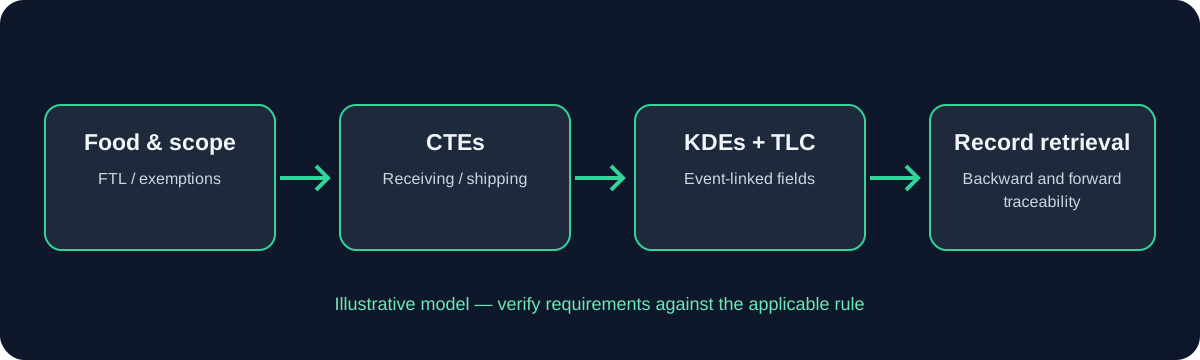
What this guide covers
Identify the listed category: Check exact FDA wording and qualifications. Some species fall into defined groups; certain products may be excluded or governed by separate provisions. Do not assume all seafood is covered alike.
Practical implementation
First land-based receiving: For food obtained from a fishing vessel, map the specific first land-based receiving event, entity, location, lot assignment, source information, and applicable KDEs.
Limitations and verification
Practical verification: Test records from landing or receiving through processing and shipment. Review other applicable seafood rules separately; this guide does not determine coverage for a particular product.
Check vessel origin and first land-based receiving
Seafood traceability analysis should distinguish the product’s regulatory identity, how it was obtained and the activities performed after landing. The first land-based receiving event has a specific rule meaning tied to food obtained from a fishing vessel; it is not synonymous with every seafood receipt. Confirm the applicable Food Traceability List entry and the exact event definition before selecting the record fields.
Maintain lot relationships through processing and distribution
Vessel, landing, supplier, receiving-facility and internal inventory identifiers may all appear in the data chain. Maintain a controlled relationship between them so users can determine which identifier refers to the source, which identifies a movement and which is the TLC. Do not combine records merely because the product description is similar; keep distinct lots distinguishable where the underlying records require it.
Test records across supplier and facility systems
If a seafood operation performs subsequent processing or transformation, map the later activity separately and preserve relevant input-output relationships. A receiving record alone will not necessarily show how a finished product relates to its source lots. The process map should reflect the actual facility workflow, including outsourced processing and third-party cold storage where relevant.
Test a selected downstream lot backward to the relevant receiving and source records and forward to customers or destinations as applicable. Verify that records received from partners are readable, complete for the applicable event and retrievable with supporting context. Use current FDA and eCFR sources for event-specific KDEs and any exemption analysis.
Practical verification points
- Record the applicable food, activity and rule provision.
- Assign an owner, source record and exception path.
- Retest the workflow after material changes and retain evidence.
Seafood chain-of-custody review
Select one downstream lot and list each record needed to trace it backward through receiving and source information. Verify that each identifier has a defined meaning and that vessel/source details are not confused with a shipment number or internal batch code. If a third party holds a record, test access to it.
If product is processed after receiving, map the input-output relationship and test both directions. Confirm that the downstream finished lot does not lose the relationship to relevant source lots during rework, repacking or system transfer.
Where seafood products differ in form or process, maintain separate scope decisions rather than copying a conclusion across the entire category. Recheck the current FTL description and event provisions.
Outsourced storage and processing controls
If a cold store, processor or logistics provider holds records or performs an activity on the business’s behalf, document which party creates each record, how the lot identifier is passed, how corrections are communicated and how records are retrieved. Outsourcing the physical activity does not remove the need to understand the applicable obligations for the entity and transaction.
Run a joint mock trace with the provider. Select a lot and ask each party to retrieve its own record, then reconcile the identifiers and quantities. Record any point where the chain relies on an email attachment or a manual cross-reference that is not indexed in the system.
Review the arrangement when service scope, facility, system or data format changes. A service-level agreement should support the operational data exchange, not merely state that the provider follows applicable law.
Example: a downstream lot contains several source lots
If a processor combines multiple source lots into one output, preserve the relationship between each relevant input and the resulting lot under the applicable requirements. A finished lot description or production date alone may not be enough to reconstruct the source relationship. Use the actual process map and rule definitions to decide what data must be retained.
Run both a backward trace from the finished product and a forward trace from each source lot. Check whether outsourced processing, rework or separate cold storage introduces another record handoff. If a partner holds the relevant record, test retrieval from that partner.
Use the exercise findings to update data exchange and lot-link controls before the next similar production run.
How to verify this information
Official and supporting sources
Verify important regulatory claims against primary sources. Draft guidance is non-binding.
Educational information only. The regulation and current official guidance control. This page is not legal advice, FDA approval, or a guarantee of compliance.