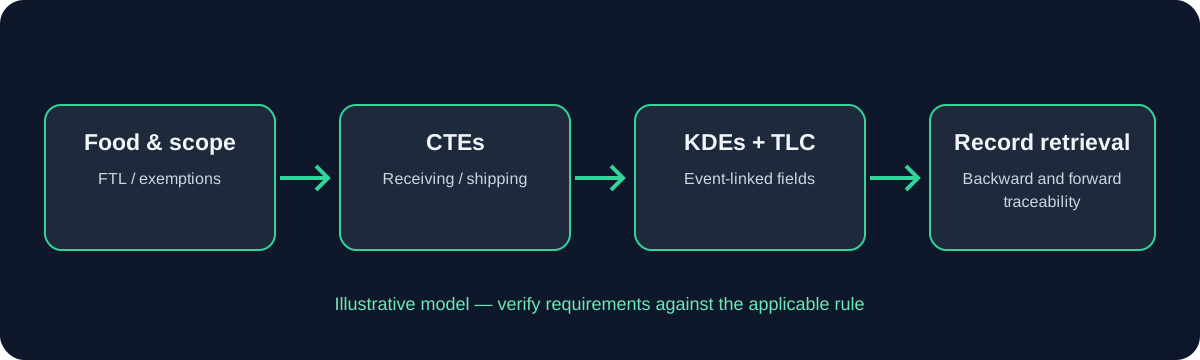
What this guide covers
The rule addresses TLC assignment at specified points, including initial packing of certain raw agricultural commodities, first land-based receiving of food obtained from a fishing vessel, and transformation. Exact duties and conditions must be verified.
Practical implementation
Keep the TLC distinct from SKU, purchase order, shipment, and work-order IDs. Link the code to source information and downstream records; test that systems preserve leading zeros and do not truncate or silently alter values.
Limitations and verification
Do not assume an internal batch code automatically meets TLC requirements or change a received TLC merely to fit an internal naming convention.
Separate the traceability lot code from other identifiers
A traceability lot code (TLC) is the identifier used to link the required records for a traceability lot. It may resemble an internal batch code, but the important issue is whether the code meets the rule’s assignment and use requirements and is carried into the applicable records. Do not assume that a UPC, SKU, purchase-order number, date stamp or pallet label is a TLC merely because it identifies something in the business system.
Control code assignment and authorised exceptions
The rule specifies circumstances in which a TLC is assigned, including initial packing for relevant raw agricultural commodities, first land-based receiving for food obtained from a fishing vessel, or transformation, subject to the applicable provisions and exemptions. Once assigned, the TLC generally remains associated with the food as it moves through the supply chain, with specific treatment when transformation occurs. Verify the exact current provisions before designing exceptions.
Verify continuity through every handoff
Create a controlled assignment procedure: who can assign a code, when assignment occurs, how uniqueness is maintained, where the code is recorded, how it appears on product or transaction records, and how corrections are approved. Keep a documented relationship between the TLC and internal identifiers if the ERP uses its own batch or inventory numbers. Do not silently regenerate a TLC because a label is damaged or a shipment is split.
Test the code through receiving, storage, split shipment, return, transformation where applicable and export. Ask a user unfamiliar with the original transaction to trace the selected lot using the records alone. If they need to infer the relationship from a handwritten note or personal memory, the linking process needs improvement.
Practical verification points
- Document who assigns and controls the identifier.
- Preserve links between internal identifiers and the traceability lot.
- Test split, correction and transformation scenarios where applicable.
TLC integrity tests
Test code uniqueness within the system design, persistence across interfaces, treatment of leading zeros, label readability, correction history and links to source and downstream records. If the business uses multiple systems, confirm that the TLC is not truncated or silently converted into a number. A code that looks the same on a screen but differs in the exported file can break the link.
When a lot is split into several shipments, confirm that each movement remains connected to the correct lot. When a transformation occurs, confirm that the relevant input-output relationships are retained under the applicable rules. When a label is damaged, follow the approved recovery process rather than creating a new code without a documented basis.
Use a sample test that a new employee can complete using only the documented procedures and available records. If the employee needs to ask the original operator what a code “really means,” improve the data dictionary or record linkage.
Code governance across systems and trading partners
Choose a controlled owner for the code format and its mapping to internal inventory identifiers. If a supplier assigns the TLC, the receiving procedure should preserve it and document any internal cross-reference. If the business assigns a TLC under an applicable event, define how duplicate assignment is prevented and how the code is communicated to downstream partners.
Check integrations for data-type conversion. Some systems treat codes as numbers and remove leading zeros; others truncate long values or convert special characters. Use test data that includes the longest supported code, leading zeros and realistic punctuation, then verify the exported result matches the source exactly.
If a partner changes the code format, assess the effect on existing records, labels, data exchanges and traceability tests before accepting the new format. Keep old-to-new mappings only where they accurately represent the relationship; do not use a mapping to hide a change in lot identity.
How to review TLC changes and historical records
If the business changes a code format, document the effective date, reason, affected products, systems and partners. Determine whether existing records still use the old format and ensure they remain searchable. A new format should not make historic lot records appear unrelated to the same physical product or cause a partner to reject a code it previously received.
Where an internal code is mapped to a TLC, retain the mapping and define whether it is one-to-one or can represent multiple units. Avoid a mapping that merges distinct traceability lots without a supported basis. Review the mapping when the business changes pack size, process, production line or system configuration.
Use a controlled test before release and keep the evidence. Include printing, scanning, manual entry, supplier/customer file exchange and export. After release, sample real transactions to confirm that the new format behaves as expected.
Example: a label reprint without changing lot identity
If a label is damaged, define whether the correct action is to reprint the existing code, create a replacement label that retains the same traceability relationship, or follow another procedure supported by the applicable requirements. The operator should not choose a new TLC simply because the original label cannot be scanned.
Record the reprint or correction according to the controlled process and retain enough history to explain which code was present and why a replacement was produced. Verify that the physical label, system record and outbound data still refer to the same traceability lot.
Test this scenario before an incident. Include a rejected label and a manual backup so staff know how to preserve the link without bypassing controls.
How to verify this information
Official and supporting sources
Verify important regulatory claims against primary sources. Draft guidance is non-binding.
Educational information only. The regulation and current official guidance control. This page is not legal advice, FDA approval, or a guarantee of compliance.