What this guide covers
FDA’s proposed extension is distinct from a final amendment. The 2026 congressional directive concerns enforcement before 20 July 2028. Do not compress these developments into “the rule was cancelled” or imply all substantive requirements were rewritten.
Practical implementation
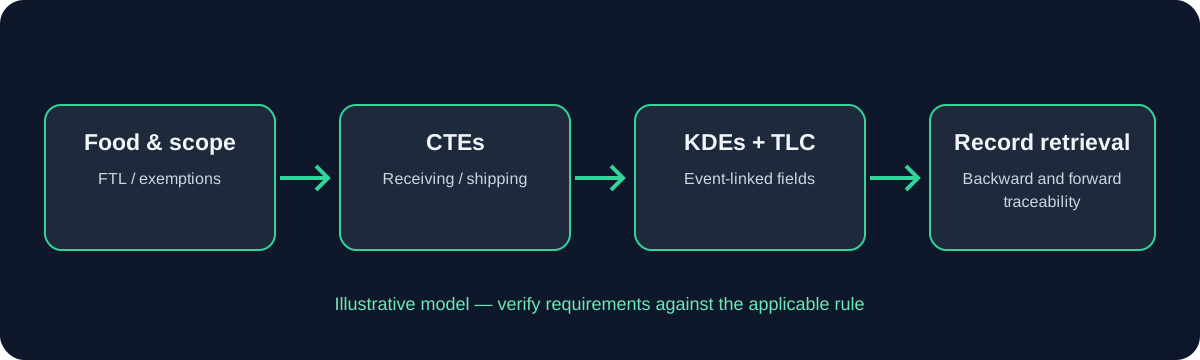
During preparation, resolve product scope, map CTEs and KDEs, align supplier data formats, review the traceability plan, and run retrieval exercises. Record official source, date checked, what changed, and which procedures need review.
Limitations and verification
This page is time-sensitive. Recheck FDA’s final-rule page, FAQs, Federal Register notices, and official updates before publication and whenever a new rule, guidance, or enforcement statement appears.
Dated update log
30 October 2026: Official FDA materials reviewed for this build. FDA describes the original date, proposed extension, and congressional non-enforcement directive. Check the source links below for later changes.
Separate the proposed extension, congressional direction and final rule
The original compliance date was 20 January 2026. FDA proposed extending it to 20 July 2028, and Congress subsequently directed FDA not to enforce the Food Traceability Rule before 20 July 2028; FDA states that it intends to comply with that directive. These are distinct legal and administrative facts. Do not simplify the status to “the rule was repealed” or imply that the underlying final rule disappeared. Check the current FDA rule page and FAQs immediately before publishing or making a compliance decision.
Use the additional time for implementation testing
A non-enforcement date is not a reason to postpone data design. Supply-chain traceability depends on trading partners capturing compatible identifiers and event data. Businesses can use the time to identify covered foods, validate supplier/customer exchanges, correct product-master data, map lot relationships, test exports and train staff. A late start may leave a company dependent on trading partners who have not yet built the required data capability.
Keep a dated regulatory-change record
Create a dated regulatory log with the source title, issuing body, publication or update date, document status (final rule, proposed rule, draft guidance, FAQ or statute), the point relied on, the pages or sections affected and the person responsible for review. Draft guidance is non-binding and should not be described as a final requirement. When official materials differ in status or wording, explain the distinction instead of silently merging them.
Before acting on a date, verify whether a later final rule, statute, court action or FDA update has changed the position. A page review date is not itself proof that the legal analysis was checked; retain a short change note describing what was checked and whether the article changed.
Practical verification points
- Record the applicable food, activity and rule provision.
- Assign an owner, source record and exception path.
- Retest the workflow after material changes and retain evidence.
A readiness plan for the period before the stated date
Use a phased readiness plan rather than a single deadline reminder. First complete scope and event mapping; next agree data definitions with suppliers and customers; then configure or adapt systems; then test records and exports; finally train users and run mock traces. Assign owners and evidence for each phase. The sequence can be adapted to the organisation, but dependencies should be visible—software testing cannot be complete while required data definitions remain unsettled.
Prioritise interfaces and partners that create the greatest uncertainty: suppliers with manual records, multiple date formats, inconsistent lot identifiers or limited retrieval capability. Test a small representative set early and expand coverage after the data mapping works. Do not wait until the final months to discover that a partner cannot provide a required field or that an export loses leading zeros.
The date-sensitive statement on this page must be reviewed against the current FDA rule page and FAQs at publication. A planning milestone is an internal target; it should not be presented as an independent legal deadline. Keep these two types of date distinct in schedules and communications.
Readiness milestones and management evidence
A useful readiness plan defines deliverables rather than vague activities. “Supplier engagement complete” should mean that the relevant supplier list has been assessed, data requirements have been agreed, a sample transaction has been tested and exceptions have a named owner. “System ready” should mean that representative records and exports passed defined tests, not that a vendor demonstration looked successful.
Include partner dependency risks. A company may control its own system but still depend on a supplier or customer to provide a usable identifier. Track which partners have confirmed the data format, which have supplied sample records and which need escalation. Where a partner cannot yet support the desired exchange, document the interim control and the unresolved risk rather than pretending the dependency is closed.
Review the regulatory status separately from the project plan. Official date statements can change; internal milestones may change too, but they are not interchangeable. The regulatory owner should record the source status and the project owner should record operational progress.
Communicate regulatory status without overstating it
When communicating the date to suppliers, customers or leadership, state the separate facts: the original compliance date; FDA’s proposed extension; the congressional direction concerning enforcement before 20 July 2028; and FDA’s stated intent to comply. Link to the current official page and record when the statement was last checked. Do not shorten this to “the rule is delayed” if that wording could imply that all underlying obligations were removed.
If a later final rule or official action changes the position, update the compliance-date page, FAQ, homepage notice, training materials and project plan together. Search the site for the old date and old wording before publishing so that one outdated paragraph does not contradict the updated page.
Keep a clear distinction between the legal position and your own readiness target. A business may set internal deadlines earlier than the date discussed by FDA; describe those as risk-management milestones rather than legal deadlines.
A tabletop exercise for leadership
Ask the leadership team to explain the current date position without using the shorthand “repealed” or “all requirements are suspended.” The team should distinguish the original date, the proposed extension, the congressional non-enforcement direction and FDA’s stated intent. Then ask who owns regulatory monitoring and how an official change would be propagated to every relevant page and procedure.
Next, review operational readiness independently of the date. Select one product and test the supplier data exchange, lot link, event record, export and response workflow. A favourable date position does not make a failed data handoff acceptable from a risk-management perspective.
Record decisions, owners and due dates. The exercise should reveal whether management understands both the legal status and the practical work still required.
How to verify this information
Official and supporting sources
Verify important regulatory claims against primary sources. Draft guidance is non-binding.
Educational information only. The regulation and current official guidance control. This page is not legal advice, FDA approval, or a guarantee of compliance.