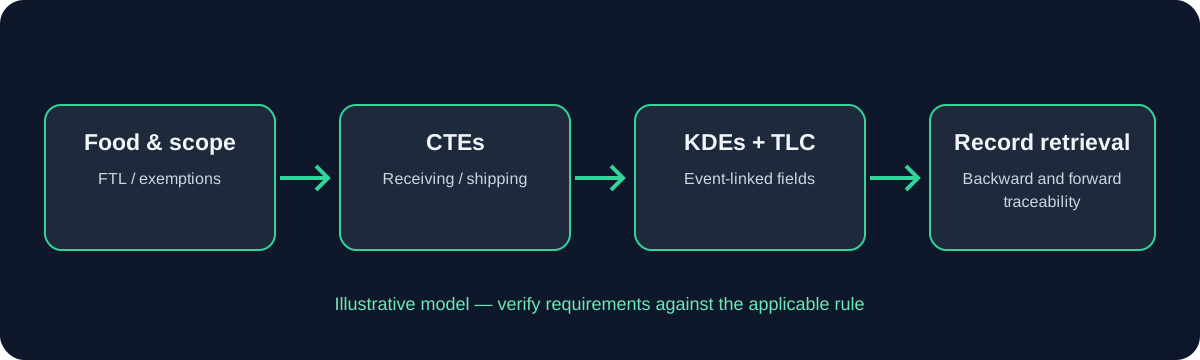
What this guide covers
Harvest records should connect the product with growing area/container, date, and other required information. Certain farm traceability plans have specific map requirements; do not confuse these with a blanket obligation to transmit field coordinates throughout the supply chain.
Practical implementation
Use controlled field/growing-area names that correspond to the applicable plan and records. Test how required information reaches the initial packer or relevant partner.
Limitations and verification
Sample fields are not a complete legal list; check the exact provision and current FDA FAQs.
Capture information while the event is observable
For a covered food and applicable operation, harvesting records must be mapped to the rule’s definition and event-specific KDE requirements. Do not assume that every farm task is a regulatory harvesting event, or that a generic harvest ticket contains all required information. Use the exact provision and FDA’s event-specific materials to determine which data apply to the food and activity.
Connect harvest records to later packing and cooling
Operationally, design the record around the point where the information is known: the product and lot identity, event date, location or growing area, quantity and other required data as applicable to the event. The form should make the correct field or area easy to select and reduce ambiguity between similarly named fields. If the business uses farm maps, ensure the names and identifiers used in the record match the controlled map.
Verify field or growing-area references
Consider a harvest lot collected across several areas or shifts. The procedure must define whether and how those units are combined and what evidence preserves the origin relationships. Do not invent a universal lot-aggregation rule; the answer depends on the business process and applicable requirements. The record should allow the business to explain how the lot was created and how later records connect to it.
Test a real harvest record through the next applicable event. Confirm that cooling or initial-packing staff can identify the lot without translating informal field names, and that any source document is legible and retrievable. Review missing location data, handwritten corrections, late entries and changes to the growing-area map as part of verification.
Practical verification points
- Record the applicable food, activity and rule provision.
- Assign an owner, source record and exception path.
- Retest the workflow after material changes and retain evidence.
Field-level record review before the season
Before harvest begins, compare the controlled farm map with the names and identifiers available on the harvest form or handheld device. Confirm that seasonal staff can select the right area without relying on local nicknames. Test whether a correction to the area identifier is recorded with enough context to understand the original entry and the change.
Choose a sample lot and follow it into the next applicable operation. If cooling or initial packing staff cannot reliably identify the source lot, the handoff procedure needs work. A completed harvest form alone does not prove that the identifier is carried into later records.
Where paper forms are used during connectivity outages, define who transcribes them, how transcription is checked and where the original is retained. The backup method should be tested before it is needed, not improvised after an incident.
Handling corrections and paper records
If a harvest record is corrected, preserve the original entry and document who made the correction, when it was made and why, consistent with the organisation’s record-control process. Do not erase an original value without a traceable correction history. The procedure should distinguish a correction to a transcription error from a change in the underlying lot or growing-area identity.
For paper forms, define how the forms are numbered, stored, transcribed and checked. If a digital copy is used, confirm that the image is legible and linked to the relevant record. Keep the process simple enough for seasonal staff to follow consistently.
Use a sample from a busy or interrupted shift to verify that the record remains complete and can be linked to cooling or initial packing where applicable.
How to verify this information
Official and supporting sources
Verify important regulatory claims against primary sources. Draft guidance is non-binding.
Educational information only. The regulation and current official guidance control. This page is not legal advice, FDA approval, or a guarantee of compliance.