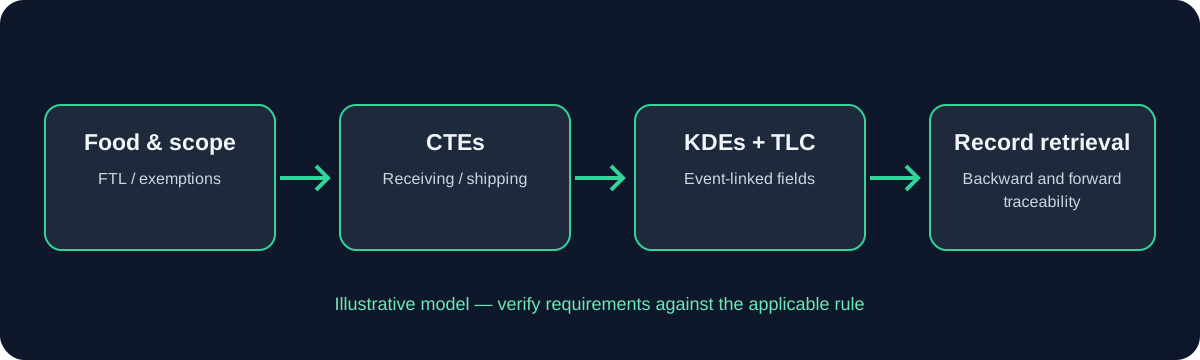
What this guide covers
Determine each entity’s role: Map the food’s path and identify which entity performs each CTE. A foreign certificate, local traceability law, or supplier audit does not automatically satisfy the U.S. rule.
Practical implementation
Cross-border data exchange: Agree on product descriptions, lot identifiers, date formats, quantities, location information, TLC/source handling, and transfer methods. Use a controlled data dictionary when partners use different terms or languages.
Limitations and verification
Record-chain test: Test the record chain across partner systems and check that identifiers survive exports and translations. Obtain specialist advice when legal frameworks interact.
Coordinate records across international data formats
Foreign firms producing food for U.S. consumption may be part of a supply chain subject to the Food Traceability Rule, but importer status alone does not answer every scope question. Determine which entity performs each activity, whether the food is on the FTL, and which provisions apply to the relevant domestic or foreign operation. Keep this analysis distinct from other importer obligations, including any applicable Foreign Supplier Verification Program duties.
Verify source and location identifiers before shipment release
International suppliers may use different date formats, location names, languages, lot-code structures and commercial documents. Establish a data dictionary and a validation process before the first covered shipment. Preserve leading zeros and punctuation in identifiers, standardise date interpretation and define how translated or converted values are checked against the source record.
Plan for time zones, language and retrieval access
When records are held by a foreign supplier or service provider, identify who can retrieve them, in what format, and how quickly the company can obtain supporting context. Confirm access during a mock trace rather than assuming an email contact or contract is enough. Consider time-zone differences and a backup contact for urgent requests.
For each supplier, keep the product-scope decision, event responsibilities, required data exchange, exception path and change notification process. Reassess when a supplier changes facility, product form, processing step or traceability system. Verify all legal conclusions against current FDA and eCFR materials.
Practical verification points
- Record the applicable food, activity and rule provision.
- Assign an owner, source record and exception path.
- Retest the workflow after material changes and retain evidence.
Cross-border data exchange test
Choose a representative shipment and compare the supplier’s original record with the importer/receiver’s stored copy. Check the exact spelling of lot identifiers, leading zeros, date/time interpretation, facility/location identifiers and whether translated labels preserve the original meaning. Keep the source record where necessary to resolve ambiguity.
Test the retrieval path with the normal contact unavailable. The backup contact should know where records are held and how to provide the supporting context. Account for time zones and different business hours in the internal response plan.
Review data exchange when a supplier changes software, document format, facility or product. A contract may remain unchanged while the practical data feed changes in a way that breaks lot-level linkage.
Example: inconsistent date and lot formats
A foreign supplier may use a different date convention or preserve a lot code as a numeric field, causing leading zeros to disappear when the file is imported. Agree on the data dictionary, compare the original and received file and validate the result before relying on the data. Do not “correct” a value by guessing when the source cannot be established.
Keep the original supplier file and the validated internal version with a clear relationship. Record the transformation rule, who approved it and how the change was tested. If the supplier changes its format, repeat the test before the new feed becomes routine.
Include a backup contact and retrieval method for records held in another time zone or by an external service provider.
Supplier escalation and document version control
For each foreign supplier, retain the current data specification and identify the version used for each shipment period. If the supplier changes its form or field names, test a sample before relying on the new file. Preserve the original source document when values are transformed or translated for internal use.
Create a clear escalation path for missing data: operational contact, quality/regulatory contact, backup contact and decision owner. The procedure should define how unresolved data gaps are recorded and how the company determines whether a transaction can be treated as complete.
Review the arrangement after a supplier-site change, merger, new logistics provider, system migration or change in product form. Each can affect the source record or data handoff.
How to verify this information
Official and supporting sources
Verify important regulatory claims against primary sources. Draft guidance is non-binding.
Educational information only. The regulation and current official guidance control. This page is not legal advice, FDA approval, or a guarantee of compliance.