What this guide covers
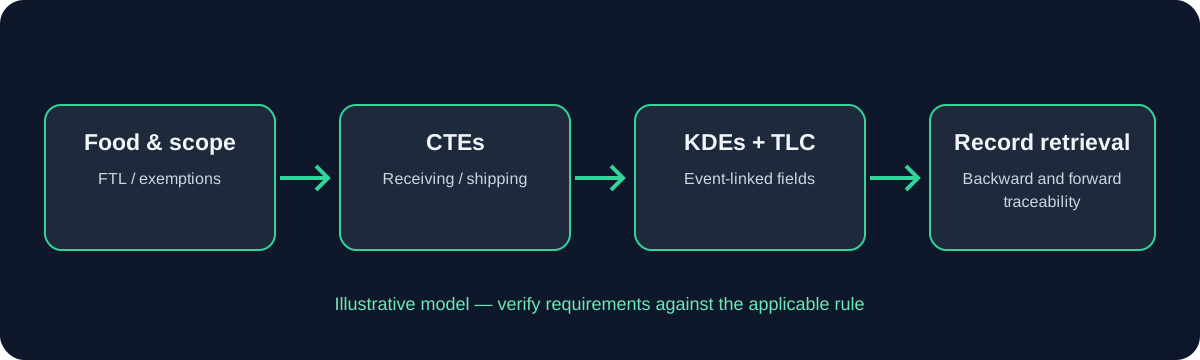
Module 1: scope—find the FTL, compare the product, identify exemptions, and escalate uncertainty. Module 2: CTEs/KDEs—map actual events and required data to source records.
Practical implementation
Module 3: TLCs and retrieval—preserve identifiers and source information. Receiving, warehouse, QA, IT, and management roles should practice their own tasks using realistic examples.
Limitations and verification
A quiz or training record is evidence of learning activity, not proof of legal compliance. Update training when processes or official guidance change.
Recommended learning sequence and competency checks
Begin with scope: what the Food Traceability List is and why the exact food form matters. Then teach event identification, event-specific KDEs, TLC relationships, record retrieval and exception handling. Employees should understand the parts of the process they perform and know where to escalate a scope or data-quality question; not every role needs to memorise the entire regulation.
Use role-based exercises. A receiving employee can be asked to reconcile a supplier lot with the receiving record; a packing operator can demonstrate the approved assignment process where applicable; a system owner can produce a sortable export; and a supervisor can explain how a missing identifier is documented and resolved.
Keep a record of the training version, attendees, date, assessment and follow-up for failed answers. Retrain when the workflow or system changes. This educational material is not a formal certification or proof of regulatory compliance.
How to verify this information
Official and supporting sources
Verify important regulatory claims against primary sources. Draft guidance is non-binding.
Educational information only. The regulation and current official guidance control. This page is not legal advice, FDA approval, or a guarantee of compliance.