What this guide covers
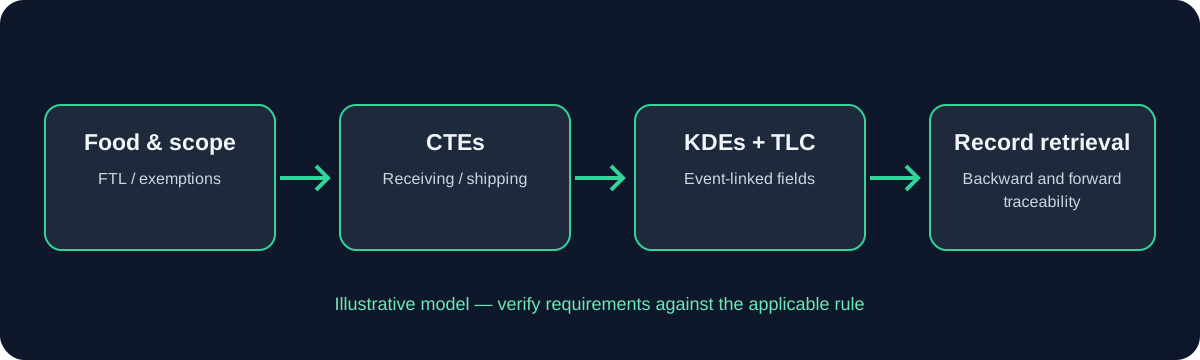
Map incoming product, packing location, event date, TLC assignment process, and required KDEs. Verify who assigns the TLC and how source information is recorded.
Practical implementation
Maintain relationships between incoming harvest/cooling records and initial-packed lots. If products are combined or reworked, check whether transformation applies.
Limitations and verification
Do not assume every repacking or packaging operation is legally initial packing.
Treat traceability-lot-code assignment as a controlled decision
Initial packing is a defined event in the Food Traceability Rule for covered raw agricultural commodities other than food obtained from a fishing vessel. It should not be equated automatically with every later packaging, labelling or case-packing operation. Compare the actual operation with the regulatory definition and document why it is or is not the relevant event.
Preserve upstream and downstream relationships
Where the applicable provisions require a traceability lot code to be assigned at initial packing, the procedure should define the authorised assignment point, format, uniqueness controls, record owner and communication method. The code should not be treated as a decorative label: it is a key link between the event record and later records. Do not assume that a customer-facing SKU, date code or purchase-order number is an acceptable substitute without checking the rule and how the identifier functions.
Validate re-packing and mixed-lot scenarios
If product from different source lots is combined, repacked or split, determine the actual operation and applicable traceability treatment before setting the system rules. The software should preserve enough history to explain what went into each resulting lot and where the output moved. A single output code that erases all input relationships can undermine the ability to trace affected product.
Test the process with a sample lot from source document to label, packing record, shipment record and sortable export. Confirm that label reprints, voided codes and manual overrides are controlled and auditable. Train operators on what to do when the source lot is missing or does not match the paperwork; do not let them invent a code merely to complete the transaction.
Practical verification points
- Document who assigns and controls the identifier.
- Preserve links between internal identifiers and the traceability lot.
- Test split, correction and transformation scenarios where applicable.
Lot-code assignment controls at the packing line
At the point of assignment, the operator should know which product and source lot are being packed, which code is being assigned, and how that code is recorded and communicated. If labels are reprinted or a code is voided, the procedure should explain how the system preserves a clear history. An unauthorised manual override can create two physical labels for one lot or disconnect a case from the packing record.
Check the first production run after a code-format change, printer replacement or system migration. Confirm that the code is legible, stored without truncation, available in downstream records and preserved in the sortable export. Test the process using a label reprint and a rejected label so that staff know the approved route.
If the operation combines or repacks lots, document the actual input-output relationship and verify the legal treatment before configuring automatic code generation. A software default should not determine the legal conclusion.
Packing-line reconciliation and record closure
At the end of a packing run, reconcile the product quantity, assigned code, labels used, voided labels and records generated according to the site’s controlled process. The reconciliation is an internal control designed to detect unexplained code gaps or mismatches; it should not introduce arbitrary legal requirements beyond the applicable rule.
If operators stop a line, restart it or change source material, define when a new lot or record is required under the actual procedure and rule. Do not rely on memory to decide which source lot applies after a break or shift change. Use a documented handoff and make the current lot identity visible at the line.
Sample records from different shifts and operators. A process that works only for one experienced operator is not sufficiently standardised.
How to verify this information
Official and supporting sources
Verify important regulatory claims against primary sources. Draft guidance is non-binding.
Educational information only. The regulation and current official guidance control. This page is not legal advice, FDA approval, or a guarantee of compliance.