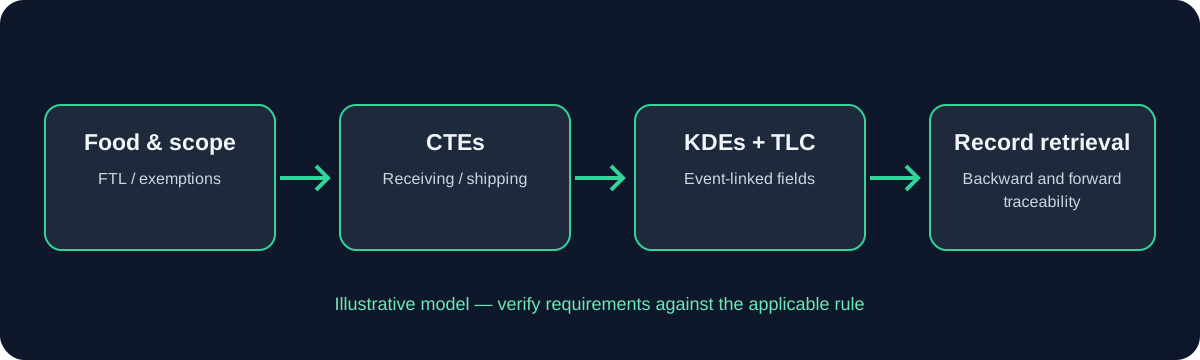
What this guide covers
Document the process step, location, date, product identity, and required KDEs for the relevant activity. Do not label every temperature-controlled storage step a CTE.
Practical implementation
Review the map with operations and QA staff, and connect applicable cooling records to related initial-packing records.
Limitations and verification
Temperature logs may be useful operational records, but are not automatically FSMA 204 KDEs unless the provision requires them.
Capture the event timing and lot identity
The rule’s cooling CTE is specific: cooling before initial packing for covered raw agricultural commodities other than food obtained from a fishing vessel. Do not label every temperature-control step “the FSMA 204 cooling event.” First confirm that the product and activity meet the regulatory definition, then use the exact KDE requirements for that event.
Design the handoff to initial packing
In a practical workflow, the record needs to identify the relevant food and lot and capture the event-specific data required by the rule. Operational temperature logs may be useful for food-safety management, but they should not be assumed to substitute for all traceability KDEs. Keep food-safety monitoring records and traceability event records linked where useful, while clearly identifying their different purposes.
Review records for delayed or split operations
Where cooling and initial packing occur at different times, locations or under different teams, define how the lot identity travels with the product. A shift handover, pallet split or temporary storage step can create a gap if one team uses a field label and another uses a packing-line code. Establish a reconciliation point before the next event is closed.
For verification, sample records from normal and exception conditions: delayed cooling, rework, a split batch or a handwritten backup record. Confirm the event date and lot reference can be reconciled, required information is present, and the record can be retrieved with the supporting context. Apply the rule’s actual record requirements rather than adding arbitrary fields to every cooling log.
Practical verification points
- Record the applicable food, activity and rule provision.
- Assign an owner, source record and exception path.
- Retest the workflow after material changes and retain evidence.
Cooling record review: focus on the event boundary
The main question is whether the cooling activity meets the rule’s specific definition before initial packing. A routine cold-storage log after packing may be important for food safety but should not automatically be labelled the traceability-rule cooling CTE. Keep the scope rationale with the process map so teams use the same interpretation.
Where the operation uses multiple rooms, contractors or shifts, identify how the relevant lot is associated with the cooling event record. If product waits in a staging area or moves between cooling units, document the operational handoff and verify that the required record can still be retrieved.
Use a sample audit to compare the traceability record with the underlying operational log. Check lot identity, event date, source location and any other KDEs required for the event. Do not assume that a temperature log alone covers the event-specific record requirements.
Staff handoff between cooling and packing
The handoff should identify which lot is being transferred, which event record has been completed and which identifier the next operation should use. If product is staged or moved between areas, make sure the lot remains identifiable and the event record can be retrieved. A generic pallet label may be useful operationally but should not obscure the traceability lot relationship.
Where a cooling record is generated in a separate system from the packing record, define how the records are linked and who checks that the link is present. Keep food-safety monitoring data available, but do not assume it automatically contains every traceability KDE required for the applicable event.
Periodically test a sample that crosses shifts or storage areas. These are common places for informal naming and delayed data entry to break the record chain.
How to verify this information
Official and supporting sources
Verify important regulatory claims against primary sources. Draft guidance is non-binding.
Educational information only. The regulation and current official guidance control. This page is not legal advice, FDA approval, or a guarantee of compliance.