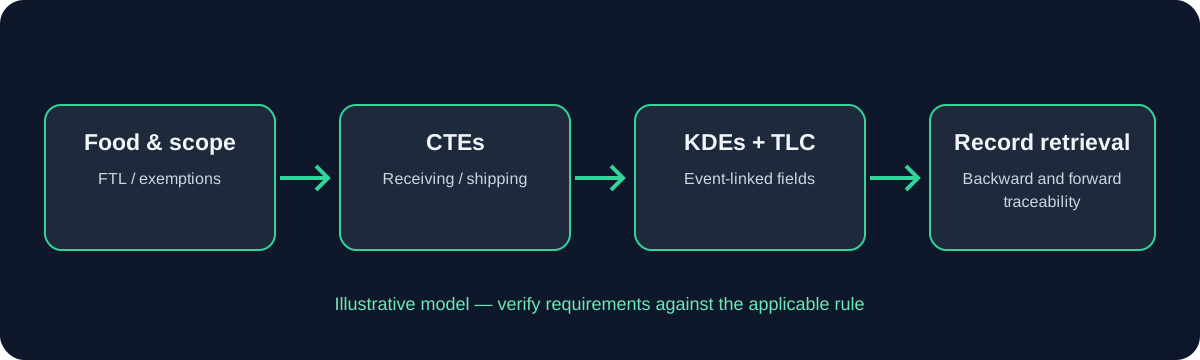
What this guide covers
Document the process, input/output products and lots, locations, dates, and required KDEs. Determine whether and how a TLC is assigned or changed under the rule.
Practical implementation
Create a controlled link between input lots and output lots. Test backward and forward tracing, including mixed batches or rework where relevant.
Limitations and verification
Do not treat every processing step as transformation without checking the legal definition.
Model inputs, outputs, rework and by-products carefully
Transformation involves an activity defined by the rule in which food is manufactured or processed, subject to the regulatory wording and conditions. A change to an ERP description or warehouse location is not automatically transformation; conversely, a real process that changes food may require a fresh event analysis even if the business system calls it “repack” or “production update.” Map the physical process, then apply the regulation.
Do not confuse inventory renaming with physical transformation
For applicable transformation events, the records should preserve the relationship between relevant input traceability lots and resulting output lots, along with the KDEs required by the provision. Define how the business treats multiple inputs, split outputs, rework, scrap and intermediate product. Avoid an unexplained many-to-one relationship in which the business can no longer identify which input lots contributed to a finished lot.
Test a backward and forward trace
Example: a processor uses two covered ingredient lots in one finished batch. The system should retain the input-to-output relationship so a selected ingredient lot can be traced forward to affected finished lots, and a finished lot can be traced back to the relevant inputs. The precise data required depend on the event and rule; this example illustrates relationship design, not a universal field list.
Test both directions. Start with an input lot and find every affected output and subsequent shipment; then start with a finished lot and identify the input lots and supporting production records. Include rework and corrections. Confirm that the exported data preserve the relationship without relying on an employee to manually reconstruct it from undocumented knowledge.
Practical verification points
- Document who assigns and controls the identifier.
- Preserve links between internal identifiers and the traceability lot.
- Test split, correction and transformation scenarios where applicable.
Input-output matrix for a transformed lot
A transformation matrix should identify the relevant input lots, the production or processing event, the resulting output lot or lots and the records that support the relationship. Include rework and intermediate product when they are part of the actual process. Do not create a simplified one-to-one mapping if the process uses several inputs or produces multiple outputs.
Run a backward trace from a finished lot to the inputs, then a forward trace from each input to all potentially affected outputs and shipments. The two directions test different failure modes: a missing input link may be visible in the backward trace, while an output not included in the forward trace may reveal a split or rework path that the system did not capture.
Keep the matrix aligned with production terminology and the actual system fields. A manually maintained spreadsheet can support the process, but it should have an owner, version control, reconciliation checks and a clear link to source records.
Control rework and intermediate lots
Rework can complicate the trace because material may move from one production run into another. Define how the business identifies the reworked material, records its source lot and links it to the resulting output. Do not rely on a general note such as “rework added” if the relevant source relationship cannot be reconstructed.
For intermediate lots stored between process steps, keep the identifier and record relationship available through the storage and transfer. If a system creates a new internal number, preserve the mapping to the relevant traceability lot and production records.
Test one ordinary transformation and one relevant exception such as rework or a split output. Use the results to validate both the procedure and the system configuration.
How to verify this information
Official and supporting sources
Verify important regulatory claims against primary sources. Draft guidance is non-binding.
Educational information only. The regulation and current official guidance control. This page is not legal advice, FDA approval, or a guarantee of compliance.