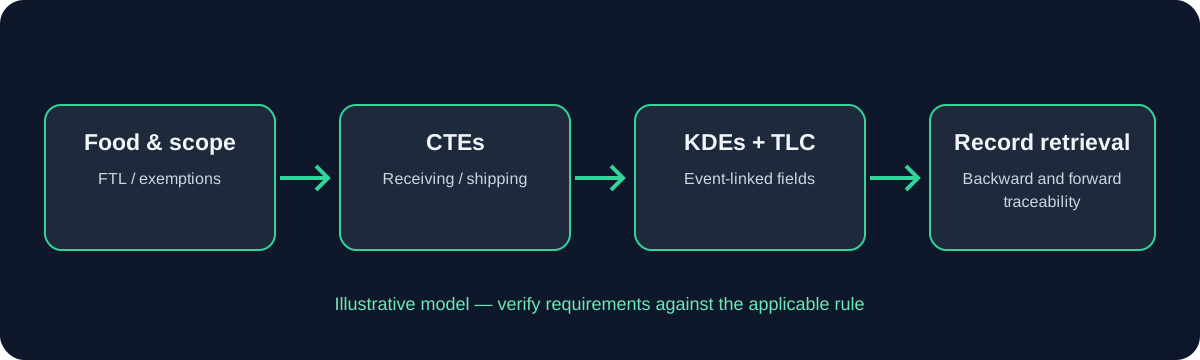
What this guide covers
Identify the vessel-to-land handoff, receiving entity/location, product, lot assignment, source information, and event-specific KDEs.
Practical implementation
Test links between landing/receiving records and downstream shipments.
Limitations and verification
Do not assume a later processor is the first land-based receiver; verify the actual chain and separate seafood rules.
Keep vessel-origin and receiving-facility data distinct
The first land-based receiving CTE applies to food obtained from a fishing vessel, subject to the rule’s definitions and conditions. The phrase is not a generic label for any seafood receipt. Determine whether the food was obtained from a fishing vessel and whether the facility’s activity is the first land-based receiving event under the applicable provisions.
Reconcile supplier records before lot release
The operational challenge is often the handoff between vessel-related information and the receiving facility’s inventory identifiers. Define how the facility records the required event data, identifies the food and lot, and retains supporting records from the vessel or supplier. If records arrive separately from the product, establish a controlled matching process rather than relying on memory or a free-text note.
Test the chain from vessel to downstream shipment
For a receiving operation handling multiple landings or mixed consignments, test whether the system can distinguish the relevant lots and preserve the source relationships. If the facility later combines, processes or repacks seafood, reassess the subsequent event mapping rather than assuming the first-receiving record covers all later activities.
A useful mock trace starts with a selected outbound lot and works backward to the receiving record and source information. Confirm that names, dates, quantities and identifiers reconcile; explain discrepancies; and ensure the records can be exported and understood by someone who did not create them. The exact required KDE list must come from the relevant rule provision, not from a generic seafood checklist.
Practical verification points
- Record the applicable food, activity and rule provision.
- Assign an owner, source record and exception path.
- Retest the workflow after material changes and retain evidence.
Receiving reconciliation: vessel information to facility records
At receipt, assign clear responsibility for matching source information to the physical product. Define what happens if a landing document arrives after the product, if the lot identifier is illegible, or if multiple consignments arrive together. The exception should preserve the unresolved status and identify the person who can authorise correction.
Where the receiving facility creates an internal lot number, retain the link to the traceability lot code and source identifiers. Ensure that downstream users can search using the identifier present on the product or accompanying records, not only an internal code known to one team.
Use an exercise that begins with a downstream lot and traces back through the receiving record to the relevant source documents. Include a case where the supporting record is held by a partner or stored separately from the receiving system.
Facility handoff and data ownership
Before receiving operations begin, define who checks source documents, who records the event, who assigns or records the relevant lot identifier where applicable, and who resolves discrepancies. The procedure should distinguish information that must be captured at the event from supporting material that may arrive later, while ensuring that the required record is not treated as complete without the necessary evidence.
If a supplier or vessel representative uses an identifier that differs from the receiving facility’s internal number, keep the original identifier and a controlled mapping. Ensure downstream teams can locate the lot from the identifier on the product or documents. Avoid relying solely on an internal code that cannot be resolved outside one system.
Run a sample reconciliation from source documents through receiving and subsequent distribution. Include a case where the supporting document arrives late or the identifier is difficult to read, and confirm that the exception procedure works.
How to verify this information
Official and supporting sources
Verify important regulatory claims against primary sources. Draft guidance is non-binding.
Educational information only. The regulation and current official guidance control. This page is not legal advice, FDA approval, or a guarantee of compliance.