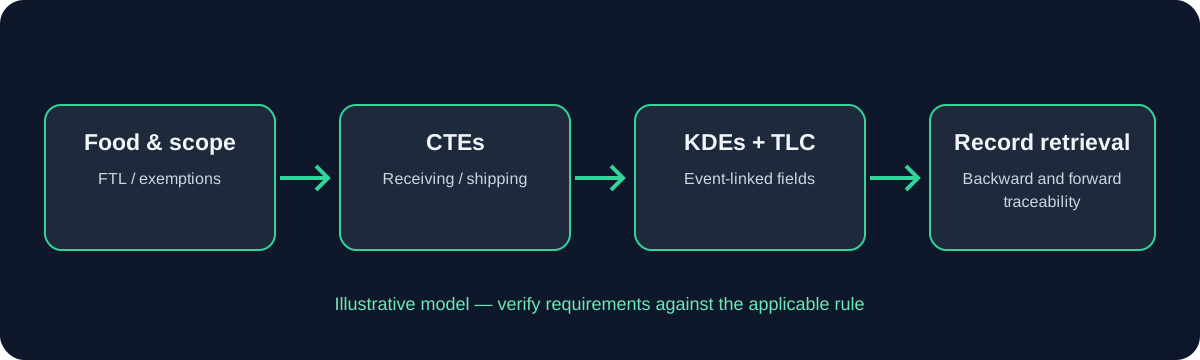
What this guide covers
Identify the products, scope decisions, activities, record systems, TLC procedures, partner interfaces, retrieval steps, responsibilities, and change controls that apply. Certain farm operations have specific map-related requirements.
Practical implementation
Use controlled sections with owners, triggers, records produced, storage locations, and escalation steps. Link to supporting matrices rather than duplicating data that changes frequently. Test the plan with a realistic lot scenario.
Limitations and verification
A generic template may omit entity-specific legal requirements. Label recommended management controls separately from mandatory elements.
Keep required plan elements separate from helpful operating detail
For entities subject to the rule, the traceability plan must include the procedures used to maintain required records and their format and location; how the entity identifies foods on the FTL that it manufactures, processes, packs or holds; how traceability lot codes are assigned when applicable; and a point of contact for questions about the plan and records. Farms growing or raising covered foods other than eggs have additional farm-map requirements described in the rule. Confirm the exact current text of § 1.1315 when preparing the controlled plan.
Connect the written procedure to records and roles
A useful plan is specific enough that a trained substitute can follow it. Name systems and record locations, not just “electronic system.” Explain the backup process, access controls, how records are retrieved, who handles a request, and how the company validates data exchanged with suppliers and customers. These supporting details improve implementation even where the exact detail is an internal control rather than a separately enumerated legal element.
Review the plan when the process changes
Keep the plan consistent with the current workflow. If a lot code is assigned at initial packing, the plan should identify the role and process responsible, the source record and the way the code is communicated. If a third-party warehouse maintains some records, the plan should explain how the company can obtain and provide them. If a record is linked electronically, test that the link works for an authorised user during an incident.
Control revisions through an owner, version number, approval date, change summary and training trigger. Retain prior versions according to the applicable rule and internal document-control procedure. Review after new product scope, process change, system migration, acquisition, supplier change or a failed mock trace. A signed plan that does not match actual practice is a document-control failure, not evidence of readiness.
Practical verification points
- Record the applicable food, activity and rule provision.
- Assign an owner, source record and exception path.
- Retest the workflow after material changes and retain evidence.
Traceability plan review questions
Can a person who did not write the plan identify where the records are stored? Can they determine which foods are in scope? Can they explain when a TLC is assigned and who is authorised to assign it? Is the point of contact current? If a farm map is required, does the map use identifiers that match the actual records? These questions reveal whether the plan is operational or merely descriptive.
Compare the plan against a walk-through at the facility. Select a recent transaction and verify each stated procedure: the record location, the identifier, the retrieval route and the staff role. Mark any mismatch and update either the plan or the actual process through controlled change management. Do not change the written procedure just to make an audit sample appear consistent without confirming the intended process is sound.
Retain evidence of review, approval and staff communication. When a revision affects how data are entered or retrieved, training should occur before the revised process is relied on.
Plan maintenance and version control
Keep the traceability plan in the organisation’s controlled-document system, with a visible owner, version, approval and revision history. Link each procedure named in the plan to the current approved version. If the plan says records are stored in a shared folder, verify that the folder still exists, access is controlled and the responsible team can retrieve records when needed.
When a system migration or supplier change affects record location or retrieval, update the plan and train the affected staff before the new process becomes the normal method. Maintain enough history to understand which plan version applied during a prior transaction or test. The regulation contains specific retention provisions for traceability plans; confirm the current text when setting the retention schedule.
An annual review may be a useful internal control, but the plan should also be reviewed after material changes and failed tests. A calendar review alone can miss a major process change that occurs the day after the review.
Connect the plan to the supporting procedures
The traceability plan should point to controlled procedures for product identification, record maintenance, lot-code assignment where applicable, retrieval and contact responsibility. Keep supporting procedures separate where that makes them easier to update, but make the links explicit. A reviewer should not have to infer which procedure governs a step mentioned in the plan.
Use a cross-reference table with the plan element, procedure/document, owner, current version and last verification date. Check the table after document renaming, system migration or staff turnover. Broken links and obsolete titles are small administrative defects that can become operational problems during an urgent request.
After a mock trace or audit finding, ask whether the issue requires a plan revision, a procedure revision, a system change, training or some combination. Update the appropriate controlled document and retain evidence that affected staff were informed.
Example: a plan review after a warehouse change
If a company moves covered product to a new warehouse, review whether the new location performs different activities, maintains any records on the company’s behalf or uses different identifiers. Update the process map, data exchange, retrieval contact and relevant plan references. Do not assume that the same procedure remains adequate because the new warehouse uses similar software.
Test a transaction through the new facility and verify the source record, receiving/shipping events as applicable, lot identifier and export. Confirm that the contact named in the plan can retrieve records and that any third-party contract supports access when required.
Retain the old plan version and the change record. Train affected staff before the new process becomes routine.
How to verify this information
Official and supporting sources
Verify important regulatory claims against primary sources. Draft guidance is non-binding.
Educational information only. The regulation and current official guidance control. This page is not legal advice, FDA approval, or a guarantee of compliance.