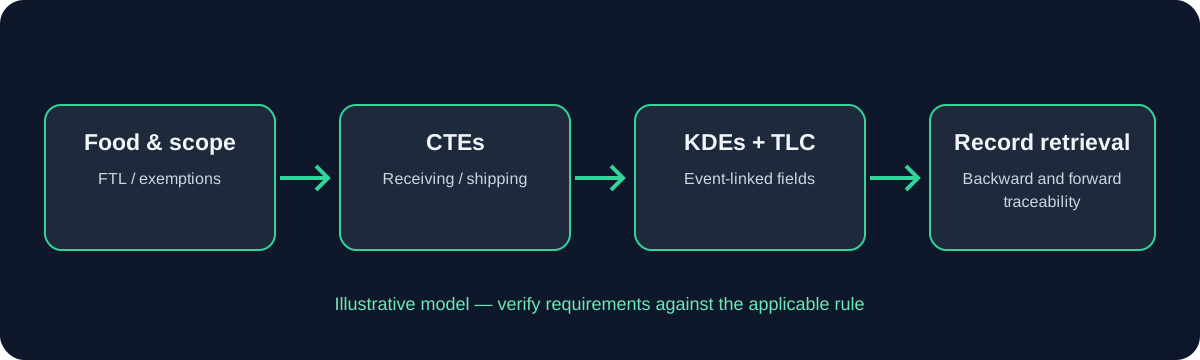
What this guide covers
FDA’s current public page describes the original 20 January 2026 date, proposed extension to 20 July 2028, and 2026 congressional directive not to enforce before that date. FDA says it intends to comply.
Practical implementation
Maintain source name, URL, date checked, claim supported, pages affected, and whether the change concerns law, guidance, or enforcement. Recheck FTL, exemptions, CTE/KDE, TLC, and plan material.
Limitations and verification
A proposed rule, draft guidance, enacted law, enforcement directive, and meeting announcement have different effects. Do not report a proposal as final.
Distinguish a final rule from a proposal and draft guidance
Regulatory monitoring is more reliable when each item has a status label. A final rule, proposed rule, statute, FDA FAQ, draft guidance and public meeting document do not have the same legal effect. Record the issuing body, document title, publication or update date, status, relevant provision and the site pages that may need revision. A source can be informative without creating a new binding requirement.
Use a controlled review log
The current FDA description of the Food Traceability Rule states the original compliance date, the proposed extension to 20 July 2028 and the congressional direction that FDA not enforce before that date, while stating FDA intends to comply. Preserve that distinction in the article. Do not write that the rule was repealed or that every provision is suspended unless a primary source supports that exact conclusion.
Do not infer legal effect from publication alone
For each review, record what changed, what did not change, who reviewed it and which pages were checked. When no change is needed, a short dated note is still useful. For a draft guidance, include its draft status and comment deadline where relevant; do not present its recommendations as binding law.
Recheck high-impact pages before publication and after major FDA updates. At minimum, keep the compliance-date page, exemptions, FTL, event-specific guides, FAQ and regulatory source register aligned. A review date in the footer should reflect an actual review, not merely the date the HTML file was generated.
Practical verification points
- Record the applicable food, activity and rule provision.
- Assign an owner, source record and exception path.
- Retest the workflow after material changes and retain evidence.
Recent official material to monitor
FDA’s current Food Traceability Rule page describes the original 20 January 2026 compliance date, the proposed extension to 20 July 2028, and the congressional direction not to enforce before 20 July 2028; FDA states that it intends to comply with that directive. Keep these facts distinct: a proposed extension, a statutory non-enforcement direction and the text of the final rule are not identical legal concepts. Recheck the primary FDA page before relying on the date in a procedure or external communication.
In October 2026, FDA also published draft guidance concerning an enforcement policy for certain retail food establishments and restaurants. FDA labels the document draft and non-binding and invites comments by 23 November 2026. Do not describe this draft as a final rule or as a universal exemption. Review its precise scope and status before referencing it in a retail or foodservice applicability analysis.
FDA has also described planned quarterly engagement with regulated entities about possible flexibilities for satisfying the lot-level tracking requirement. Discussions, draft recommendations and public meetings can inform implementation planning, but they should not be represented as operative requirements unless a primary source establishes that effect.
For each update, store the official title, publication date, status, relevant URL, claims affected, pages reviewed and reviewer. If a source is draft, label it as such in the page text and source register. When no change is needed, record that the source was checked and explain why the existing article remains accurate.
Editorial process for a date-sensitive update
Before changing the site, compare the current official source with the wording already published. Identify whether the source is final, proposed, draft, explanatory or statutory, and state the effect it actually supports. If the source changes a compliance-date explanation, update the page notice, FAQ, training material and any page that repeats the date.
Keep the previous wording in the change log with the date, source and reason for revision. This makes it possible to explain why a page looked different at an earlier time and helps avoid accidental reversion to outdated wording during later edits.
For future monitoring, assign an owner and a repeatable review schedule. A date displayed in the footer should be updated only after a real source review.
How to verify this information
Official and supporting sources
Verify important regulatory claims against primary sources. Draft guidance is non-binding.
- FDA — Food Traceability Final Rule
- FDA — Actions Related to the Rule (2026)
- FDA — Draft Q&A Guidance (non-binding)
- FDA — Food Traceability List
- FDA — Food Traceability Rule FAQs
- FDA — Draft guidance on enforcement policy for certain retail food establishments and restaurants (October 2026; non-binding draft)
Educational information only. The regulation and current official guidance control. This page is not legal advice, FDA approval, or a guarantee of compliance.