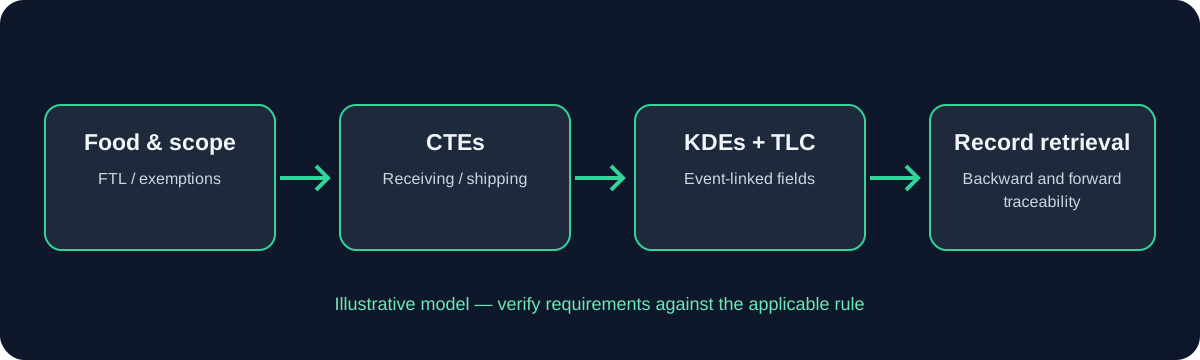
What this guide covers
Whole versus fresh-cut: Record the product description and processing state. If the product contains mixed ingredients, check the rule’s condition for listed foods used as ingredients and whether the listed food remains in the same form.
Practical implementation
Processing and lot relationships: Cutting, mixing, washing, packing, and distribution may affect event mapping. Determine which activities meet the CTE definitions and link relevant incoming lots to outputs where required.
Limitations and verification
Practical verification: Use a fictional mixed-greens flow to test input records, applicable events, TLC relationships, and shipment records. Do not treat the exercise as a legal coverage decision.
Control field, harvest and packing identifiers
Leafy greens are frequently discussed in traceability planning because product identity and source information can become difficult to reconstruct after rapid harvest, cooling, packing and distribution. However, do not use the phrase “leafy greens” as a substitute for checking the precise Food Traceability List entry, product form and operation. The exact rule language controls scope.
Plan for rapid aggregation and split-lot questions
Field names, harvest dates, crew records, cooling records and packing-lot identifiers should be joined through a defined data relationship. If an operator writes a field nickname on a paper ticket while the digital system expects a numeric code, define how that value is reconciled and how corrections are recorded. Do not allow informal labels to become the only evidence of origin.
Test traceability under seasonal conditions
Run a scenario in which a selected packed lot must be traced back to the relevant harvest and growing-area records, then forward to each shipment that received product from that lot. Include split cases and any commingling or repacking that actually occurs. The trace should be explainable from records rather than relying on assumptions about how the operation usually runs.
Seasonal readiness should include temporary-worker training, label supplies, offline record procedures, shift handoffs and a named backup for data entry or retrieval. Recheck the procedure when product, field layout, packing line or customer data requirements change.
Practical verification points
- Record the applicable food, activity and rule provision.
- Assign an owner, source record and exception path.
- Retest the workflow after material changes and retain evidence.
Mock trace for a packed leafy-greens lot
Select a packed lot and trace backward to the records that identify the relevant source area and harvest/packing activity as applicable. Then trace forward to each shipment containing the selected lot. Check whether the identifiers in the field records, cooling records, packing labels and shipping documents match or have a documented mapping.
Include a realistic exception: a late paper ticket, a label reprint, a split pallet or a change of shift. The exercise should show whether the procedure preserves the relationship when the normal digital path is interrupted.
Use the findings to improve field selection, handoff labels, record timing and staff instructions. Avoid adding burdensome fields unless they support a requirement or solve a documented operational problem.
Managing handoffs and exceptions during peak volume
Peak season increases the likelihood of late records, temporary staff, label reprints and rapid lot movement. Define a simple exception route that identifies the affected product, preserves the original information, assigns a responsible person and prevents a missing identifier from being treated as resolved without evidence.
Use short, role-specific instructions at the point of work: how to select the correct growing area, how to identify the lot on the record, where to place the record, and whom to contact when the data do not match. Detailed legal interpretation should remain available in the controlled procedure, but the immediate action should be clear.
After peak season, review recurring errors and revise the procedure before the next cycle. Keep the review based on actual records and failures rather than a general statement that staff were retrained.
Example: field identifier mismatch at packing
If the harvest record uses a field nickname while the packing record uses a formal field code, establish a controlled mapping and preserve the original entry. The mapping should identify who maintains it and which version applied to the transaction. Do not rely on the same supervisor being available to translate the two values during a trace.
Test whether a packer can identify the correct field from the controlled record and whether the result can be traced forward to outbound lots. Include a new or temporary worker in the exercise to reveal whether the procedure depends on local knowledge.
Correct the form, label or system lookup that caused the mismatch and sample subsequent records to verify that the defect has stopped.
How to verify this information
Official and supporting sources
Verify important regulatory claims against primary sources. Draft guidance is non-binding.
Educational information only. The regulation and current official guidance control. This page is not legal advice, FDA approval, or a guarantee of compliance.