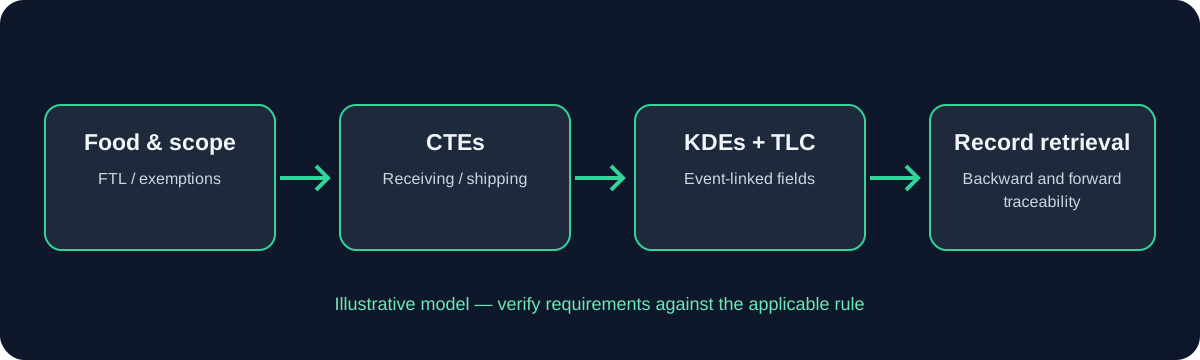
What this guide covers
Check exact cheese category: Match the product specification to the exact FTL wording, including pasteurized/unpasteurized categories and listed exclusions. Do not infer coverage from “dairy” as a broad label.
Practical implementation
Batch and transformation links: Map receiving, blending, processing, packing, holding, and shipping as actually performed. Check which activities are CTEs and preserve input/output lot relationships where required.
Limitations and verification
Practical verification: Review specifications, process flow, supplier records, and shipment documents. Seek qualified review when category or exemption language is unclear.
Do not infer FTL coverage from the word “dairy” alone
Dairy businesses may handle many product forms and processes, but the broad category “dairy” is not itself a scope determination. Compare each product with the exact current Food Traceability List description and assess whether the listed food remains in the relevant form when used as an ingredient. Product specifications, processing state and intended use can affect the analysis.
Connect ingredients, production lots and shipments
Build a product register that distinguishes raw materials, ingredients, intermediate products and finished goods. Where a covered food is used in a transformation, preserve the required relationship between relevant input lots and resulting output lots. The product master should identify the evidence used for the scope decision and trigger review after formulation or process changes.
Coordinate supplier and customer identifiers
If a dairy facility receives covered ingredients, processes them and ships finished products, map receiving, transformation and shipping separately as applicable. Do not assume that a single finished-product batch number proves all upstream lot relationships. Verify that the data system can identify affected finished lots from an input lot and identify relevant inputs from a finished lot.
Coordinate supplier and customer identifiers so that lot codes remain interpretable across systems. Test split shipments, rework and corrections if those occur in the process. This guide is a planning aid; the exact product and activity scope must be confirmed against the regulation and current FDA material.
Practical verification points
- Record the applicable food, activity and rule provision.
- Assign an owner, source record and exception path.
- Retest the workflow after material changes and retain evidence.
Dairy product change-control scenario
If a facility changes a formulation, supplier or processing step, the product’s FTL analysis should be reviewed before the change becomes routine. A product name may remain the same while an ingredient’s form or the finished product’s processing changes. The review should capture the revised specification, relevant list entry, processing facts and the reason the scope conclusion remains valid or changes.
For covered inputs, check whether the receiving and transformation records preserve the required lot relationships. A finished batch number can be operationally useful but should not erase the link to input lots where that link is required. Test a finished lot and an input lot in both directions.
Where production, quality and warehouse systems are separate, define the authoritative source for each identifier and the reconciliation process. Avoid manual duplicate entry unless there is a controlled check.
Example: one covered input contributes to several output lots
Where an applicable transformation uses a covered input in multiple production runs, preserve the input-to-output relationships for each relevant output. Do not assume the ingredient lot can be identified from the finished-product date alone. Confirm the actual process and the rule-specific record requirements.
Test forward from the input to all affected output lots and backward from one output to the relevant input records. Check whether rework, intermediate storage or system transfer can break the relationship.
If the product formulation or processing method changes, review the product-scope decision and the transformation map together.
Data coordination across receiving, production and dispatch
Dairy operations may use separate systems for receiving ingredients, production batches, quality release and dispatch. Map which system holds each required identifier and how the lot relationships pass between them. A finished-product batch code may be central to operations, but the data design should still preserve any required link to relevant source lots.
Use a representative example that includes a receipt, a production run and an outbound shipment. Verify the records across each system and test whether a person unfamiliar with the process can reconstruct the relevant relationships from documented instructions.
Where product scope is uncertain because of form or processing, resolve that question before copying the same traceability configuration across all dairy products.
How to verify this information
Official and supporting sources
Verify important regulatory claims against primary sources. Draft guidance is non-binding.
Educational information only. The regulation and current official guidance control. This page is not legal advice, FDA approval, or a guarantee of compliance.