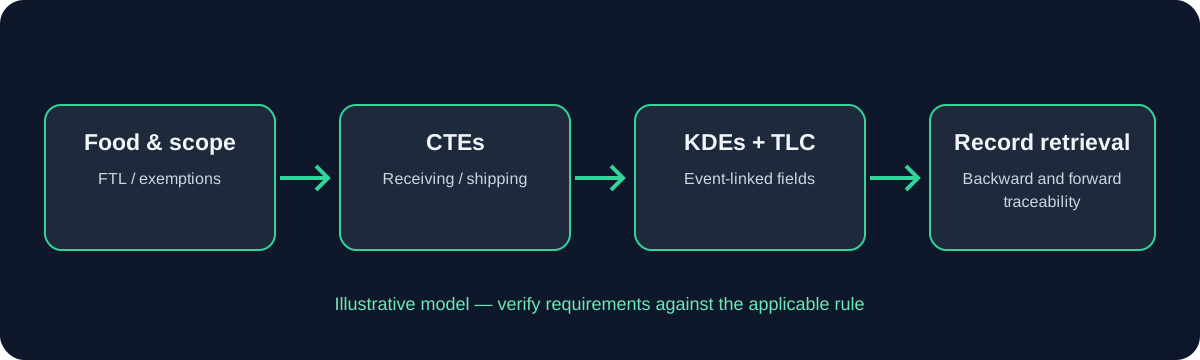
What this guide covers
Receiving and shipping: Record incoming and outgoing lot identifiers, quantities, dates, locations, trading partners, and other KDEs specified for the event. Keep original lot relationships through split shipments, pallets, and returns.
Practical implementation
Systems and data exchange: WMS, ERP, EDI, bills of lading, invoices, and portals may each hold part of the record. Map each field to its source and test exports; agree with partners how identifiers are represented.
Limitations and verification
Practical verification: Choose a received lot and reconcile all outgoing shipments and remaining quantity, then trace a shipment backward. Confirm item, lot, quantity, date, location, and partner.
Preserve supplier lot codes through warehouse transactions
A distribution warehouse may receive, store, pick, split and ship food. The rule’s applicability depends on the food and activities performed; warehouse terminology does not decide whether a CTE occurs. Map the physical process and determine which event definitions apply to the specific covered food. If the warehouse performs additional processing or transformation, reassess the scope rather than assuming the storage-only model remains valid.
Handle splits, consolidation, returns and customer orders
Warehouse systems often assign pallet IDs, license-plate numbers, bin locations and order numbers. These are useful operational identifiers but should not obscure the TLC and other required data. Maintain a reliable cross-reference so a user can move from a customer shipment to the relevant lot and from that lot to the receiving record and source information.
Verify third-party logistics access
Include split picks, partial shipments, consolidated orders, returns, rejected loads and relabelled pallets in the design. When a pallet is split, the system should preserve which lot each resulting handling unit contains. When a customer returns product, record the return and its disposition without overwriting the original shipment history.
Where a third-party logistics provider stores the records, define retrieval access, response contacts, data format and backup arrangements in the service agreement. Test the actual record retrieval with the provider; contractual language alone does not prove that the data can be obtained quickly and interpreted correctly.
Practical verification points
- Record the applicable food, activity and rule provision.
- Assign an owner, source record and exception path.
- Retest the workflow after material changes and retain evidence.
Warehouse scenario: split pallet and mixed order
Imagine one pallet is split to fulfil two orders. The warehouse should retain which lot each picked unit came from and link each outbound transaction to the relevant lot. If multiple lots are consolidated on a pallet or in an order, the records should not imply that the shipment contains only one lot unless that is true.
For returns, capture the original shipment reference, returned quantity, lot identity where available and disposition. If the product is restocked, the traceability relationship should remain understandable; if it is destroyed or otherwise removed, record the disposition through the company’s controlled process.
Run the exercise with the warehouse operator and the person who retrieves records. If either relies on a handwritten note not referenced by the system, improve the controlled link or define how the note is indexed and retained.
Warehouse master data and interface controls
Keep a controlled mapping among supplier lot, TLC where applicable, internal lot, pallet ID, bin and outbound order. Not every identifier is legally equivalent; the map exists to make relationships explicit. Verify that each interface passes the required value without truncation and that warehouse staff can search by the identifier available on the product or document.
Use a periodic reconciliation sample that compares inbound receipt, inventory movement and outbound shipment. Investigate orphan records—shipments that reference no known lot, or lots with no clear source record—rather than treating them as routine system noise.
When a warehouse management system is upgraded, repeat split-pallet, partial shipment, return and export tests. Changes to allocation logic can affect lot relationships even when the screen layout looks unchanged.
Example: customer return after a split shipment
When a customer returns part of a split shipment, connect the return to the original shipment and lot. Record the quantity returned, the product identity and the disposition according to the company’s controlled process. If the product returns to inventory, preserve the lot relationship; if it is held or destroyed, retain the disposition evidence.
Test whether the system can trace the returned units to the original outbound movement and identify any other shipments from the same lot. A return transaction that only records a generic SKU may be inadequate for reconstructing the movement of the affected lot.
Use the findings to adjust warehouse instructions and test the revised process with another representative transaction.
How to verify this information
Official and supporting sources
Verify important regulatory claims against primary sources. Draft guidance is non-binding.
Educational information only. The regulation and current official guidance control. This page is not legal advice, FDA approval, or a guarantee of compliance.