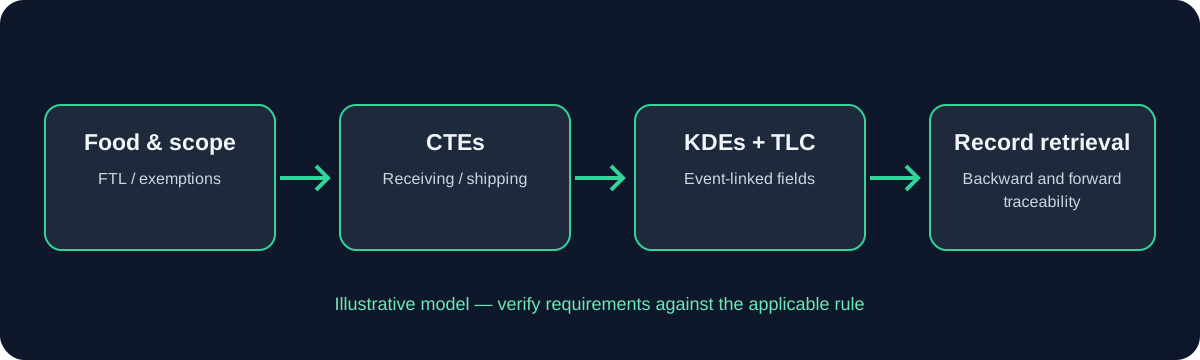
What this guide covers
Separate the KDEs required for applicable events from additional coordination fields such as internal item IDs. Label the two groups separately and cite the provision for each mandatory field.
Practical implementation
Define field meaning, format, units, date conventions, lot-code handling, responsible party, correction process, and transfer method. Test a representative file before relying on the exchange.
Limitations and verification
Keep original records, document corrected values, assign discrepancy owners, and retest after changes. A field that exists but is misinterpreted remains a data-quality risk.
Request the minimum data needed for the relevant event
A supplier request should identify the covered food, the transaction, the traceability lot and the event-related information needed by the receiving business. A vague request to “comply with FSMA 204” often produces a certificate or general assurance rather than usable event data. Tell the supplier what identifier must appear on the product and records, the format expected, when data should be provided and how corrections will be handled.
Control missing data and supplier changes
Use a supplier onboarding checklist that captures the supplier’s role in the chain, relevant products, event responsibilities, data exchange method, backup contact, record retrieval path and process for reporting a change. Confirm whether the supplier is claiming an exemption and, if so, request the basis needed to evaluate the claim. Do not assume that a supplier’s exemption eliminates all downstream responsibilities for the receiving entity.
Verify both sides of the exchange
When data are missing or inconsistent, define a controlled exception. Identify the affected lot, prevent the record from being treated as complete, contact the supplier, preserve the original submission and document the resolution. The procedure should explain who can approve closure and what happens if the information cannot be reconciled before the product moves onward.
Test supplier data with a realistic sample file. Check field definitions, date formats, leading zeros, lot-code integrity, location identifiers and whether the data can be linked to the physical shipment. Repeat after an ERP migration, supplier change or interface update. A signed supplier agreement is useful governance, but the actual exchange must work.
Practical verification points
- Record the applicable food, activity and rule provision.
- Assign an owner, source record and exception path.
- Retest the workflow after material changes and retain evidence.
Supplier onboarding questions that produce usable data
Ask the supplier which event-specific records it creates, which identifier appears on the product and transaction documents, how the required data are transmitted, and how the supplier handles corrections. Ask who can provide supporting records during an incident and who is the backup contact. These questions reveal operational capability more clearly than a generic compliance certificate.
Agree on a sample transaction before relying on the interface. Validate field meanings, date formats, location identifiers and lot-code preservation. If the supplier sends a spreadsheet, check the actual file for missing values and broken relationships rather than accepting a screenshot of the supplier’s system.
Review the agreement when product scope, process, supplier site, software or data format changes. Keep the version of the agreed data dictionary that applied to each transaction period.
Supplier performance monitoring
Monitor whether suppliers provide the agreed data accurately and consistently, not merely whether they signed an agreement. Track missing fields, identifier mismatches, late responses, unresolvable location references and recurring file-format errors. Use the results to prioritise coaching, technical fixes or escalation.
When a supplier changes its product specification, facility, system or data format, ask whether the change affects the product-scope decision or the record exchange. Require notification before the change is relied on where practicable, and validate a sample transaction under the new process.
Keep a clear route for urgent requests and identify a backup contact. Test the route with a realistic request rather than assuming that an email address in a contract is sufficient.
How to verify this information
Official and supporting sources
Verify important regulatory claims against primary sources. Draft guidance is non-binding.
Educational information only. The regulation and current official guidance control. This page is not legal advice, FDA approval, or a guarantee of compliance.