What this guide covers
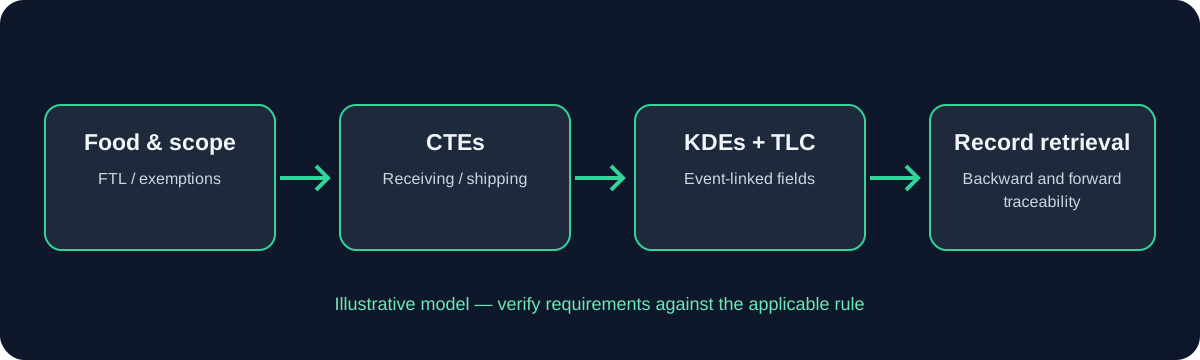
Does it apply to every business? No; assess the food, activities, and exemptions. Does it mandate software? No single commercial product is specified. CTEs are specified activities; KDEs are associated required information.
Practical implementation
Original compliance date: 20 January 2026. FDA proposed 20 July 2028 and Congress directed no enforcement before that date; FDA says it intends to comply. Routine submission of all data is not universally required.
Limitations and verification
Templates do not guarantee compliance. Verify detailed questions in Subpart S and current FDA FAQs, and use qualified review when the result turns on specific facts.
Questions that need a fact-specific scope review
An FAQ can orient a reader, but it cannot decide every case. The same food category may be handled in different forms, and the same company may perform different events. Treat any short answer as a starting point; follow the linked guide and current FDA source for the exact conditions. Where a question turns on a product specification, process step, exemption or transaction, document those facts before drawing a conclusion.
Implementation questions that are often confused
“Is my business covered?” requires at least a product-scope review, an activity map and an exemption analysis. “Do I need a traceability lot code?” depends on the event and the applicable assignment provisions. “Must I send records to FDA every month?” is not the rule’s general model; FDA requests information in certain situations, and the applicable response provision controls. Avoid turning a nuanced answer into an absolute statement without the rule citation.
When to seek a formal interpretation
When asking a supplier or customer for data, specify the food, transaction, identifier and event involved. A generic request to “send FSMA data” can produce spreadsheets that contain many fields but omit the information needed to link the lot. Use a common data dictionary and agree on how corrections, partial shipments and code changes are communicated.
Escalate questions when the facts do not fit a clear example in the regulation or FDA materials, when an exemption is decisive, or when a product is processed into a different form. Keep the question, relevant facts, sources reviewed and final decision together so the rationale can be revisited if the facts or guidance change.
Practical verification points
- Record the applicable food, activity and rule provision.
- Assign an owner, source record and exception path.
- Retest the workflow after material changes and retain evidence.
How to turn a short answer into a defensible decision
For each FAQ that asks whether a rule applies, list the facts that would change the answer. For a product-scope question, those facts may include the exact food, form, ingredient state and processing. For an event question, they may include what the business physically does and where the activity sits in the supply chain. For an exemption question, they include the specific conditions written into the relevant provision.
An FAQ answer should link to the most directly relevant FDA or eCFR source, not just to the homepage. It should also distinguish a general rule from a fact-specific exception. If official materials leave an unresolved question, state that limit and suggest qualified regulatory review rather than manufacturing certainty.
Use the FAQ as a navigation layer: each answer should point readers to a detailed guide, a practical worksheet or the exact source. Avoid repeating the same generic disclaimer after every answer when a clear site-wide disclaimer and contextual caveat will do.
How this FAQ should be used in a real decision
Use the short answer to identify the relevant topic, then read the linked guide and primary source before changing a procedure or system. Record the facts that make the answer applicable to your case. A general FAQ cannot evaluate an unseen product specification, process flow, supplier agreement or exemption record.
If an answer depends on an uncertain interpretation, record the question and escalate it. Avoid using a screenshot of a FAQ answer as the only evidence for a site-wide scope decision. Keep the exact source and the rationale with the assessment.
When official guidance changes, update the relevant answer and the deeper guide together. The FAQ should simplify navigation without becoming a separate, contradictory source of regulatory claims.
How to verify this information
Official and supporting sources
Verify important regulatory claims against primary sources. Draft guidance is non-binding.
Educational information only. The regulation and current official guidance control. This page is not legal advice, FDA approval, or a guarantee of compliance.