What this guide covers
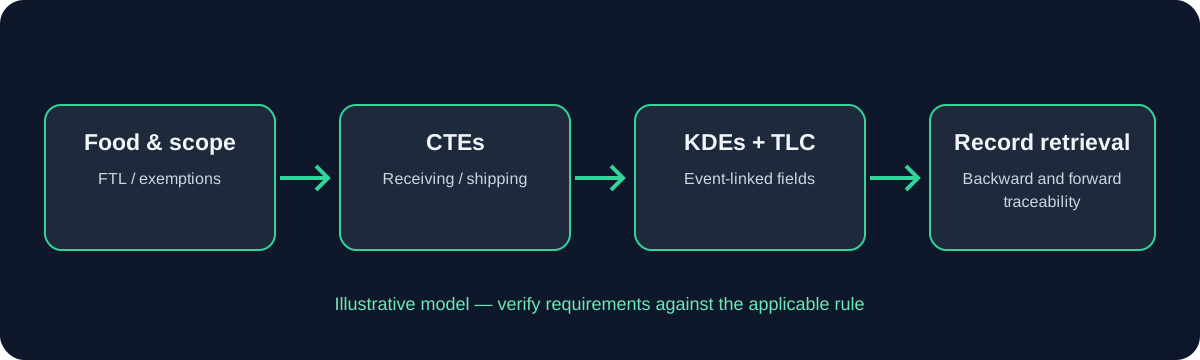
FTL identifies designated food categories. A CTE is a specified supply-chain activity. KDEs are information associated with applicable CTEs that must be maintained and/or provided. TLC identifies a traceability lot within the rule’s framework.
Practical implementation
Use the official definition and relevant provision for receiving, shipping, transformation, traceability plan, exemption, electronic sortable spreadsheet, TLC Source, and TLC Source Reference. Link definitions to the detailed guides and source text.
Limitations and verification
The terms are related but not interchangeable. Do not assume every internal batch code is a TLC or that a simplified glossary entry is a complete legal definition.
| Term | Plain-language role | What to verify |
|---|---|---|
| FTL | Designated food categories | Exact category and footnotes |
| CTE | Specified supply-chain activity | Event definition |
| KDE | Required information associated with an event | Event-specific fields |
| TLC | Traceability lot identifier | Assignment and change provisions |
| TLC Source | Physical location where code was assigned | Applicable source fields |
Do not treat similar identifiers as synonyms
Food Traceability List (FTL) identifies the foods subject to the additional traceability recordkeeping framework. Critical Tracking Event (CTE) means a specified supply-chain activity identified in the rule. Key Data Element (KDE) is information required to be maintained or provided for an applicable event. Traceability Lot Code (TLC) is the code used to link relevant records for a traceability lot. These terms work together, but each answers a different question: which food, which activity, what information and which lot link.
Use the glossary as a navigation aid, not a substitute for the CFR
In daily operations, teams often use “batch,” “lot,” “shipment,” “SKU,” “pallet ID” and “TLC” interchangeably. That creates ambiguity. A SKU normally identifies a product type; a shipment identifier identifies a movement; a pallet ID identifies a logistics unit; an internal batch may identify a production unit. Their relationships may be useful, but the procedure must state how the traceability lot code is represented and linked rather than assuming all identifiers are equivalent.
Maintain consistent language across procedures
Use the same controlled definitions in supplier agreements, work instructions, software fields, training and mock-trace exercises. If the system uses a different internal label, maintain a data dictionary that maps the label to the business meaning and legal requirement. When the regulation defines a term, the regulatory definition takes priority over a looser local usage.
When a term is unclear, follow the linked Subpart S provision and current FDA material. A glossary simplifies navigation; it does not determine whether a product or activity is covered.
Practical verification points
- Record the applicable food, activity and rule provision.
- Assign an owner, source record and exception path.
- Retest the workflow after material changes and retain evidence.
How the core terms connect in a trace
Imagine a product identified as an FTL food. The FTL decision establishes the food category being assessed. A CTE describes a defined activity that occurs in the chain. The relevant KDEs are the information required for that event, and the TLC links records for the traceability lot. If any one of these elements is misunderstood, a record can appear complete while still failing to connect the right food, event and lot.
For example, a shipment number may identify a truck movement, while the TLC identifies the lot being moved. One shipment may contain several lots, and one lot may move in several shipments. The system must preserve that relationship instead of treating the shipment number as a substitute for the lot identifier. Likewise, a SKU identifies the product type but may not distinguish a particular lot.
Use the glossary to standardise terminology across training, supplier requests, software fields and procedures. When a local term differs from the regulation, record the mapping in the data dictionary and keep the regulatory term visible.
How to verify this information
Official and supporting sources
Verify important regulatory claims against primary sources. Draft guidance is non-binding.
Educational information only. The regulation and current official guidance control. This page is not legal advice, FDA approval, or a guarantee of compliance.