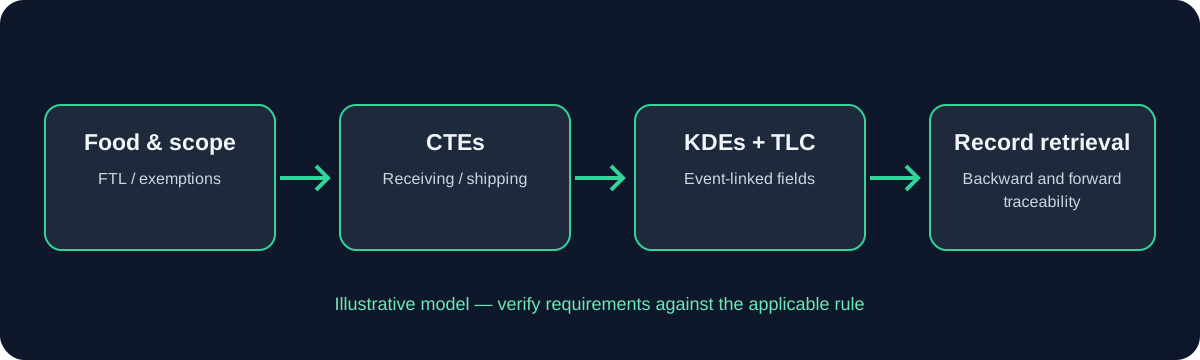
What this guide covers
Define whether the exercise tests backward tracing, forward tracing, export, partner exchange, or full lot history. Set objectives and expected records; use fictional or authorized data.
Practical implementation
Let staff use normal procedures without coaching. Record time, fields found, mismatches, help needed, corrective actions, owners, and retest results.
Limitations and verification
A successful test demonstrates performance under that scenario; it does not establish full regulatory compliance or replace other recall obligations.
Test the data path, not just individual screens
A system test should demonstrate that the business can identify affected product and retrieve the relevant records, not simply that the application opens. Define the test objective, product or lot selected, starting record, expected result, test participants, time limit used internally, data sources, export format and pass/fail criteria before starting. The internal time target is a performance measure, not a substitute for the regulatory response requirement.
Use forward, backward and transformation tests
Backward trace: start with a finished or shipped lot and identify the relevant source and prior records. Forward trace: start with a selected input or source lot and identify affected outputs and downstream movements. Transformation test: verify that input-output relationships survive the production record and export. Receipt/shipping test: reconcile both sides of the movement and explain quantity or identifier differences.
Close findings with effectiveness evidence
Include failure cases: supplier data arrives late, a lot code is entered with a missing leading zero, one shipment is split, a record is corrected, a system interface is unavailable or a key employee is absent. The purpose is not to create artificial complexity; it is to discover whether the documented backup and exception procedures work when ordinary assumptions fail.
Capture the exact records used, the export generated, gaps found, root cause, corrective action owner, due date and retest result. A mock trace that succeeds only because the original operator remembers the transaction is not a robust system test. Repeat after major system, supplier, product or process changes.
Practical verification points
- Record the applicable food, activity and rule provision.
- Assign an owner, source record and exception path.
- Retest the workflow after material changes and retain evidence.
Suggested test-case set
Use a balanced set of tests: ordinary receipt and shipment; partial shipment; a missing required value; an incorrect or truncated lot identifier; a correction after posting; a transformed lot with multiple inputs; an unavailable system; and a request for supporting records held outside the main application. Select only the scenarios relevant to the actual operation, but document why excluded scenarios do not apply.
For each test, define the starting point, expected records, required links, acceptable export and pass criteria. Save the evidence. If a test fails, do not change the expected result merely to match current system behaviour; first confirm the requirement and then correct the process or document the valid interpretation.
Repeat the relevant tests after upgrades, new interfaces, new products, supplier changes and major workflow changes. A single successful test at launch does not demonstrate ongoing control.
Define pass/fail criteria before a test starts
A pass should mean that the selected food and lot can be identified, the applicable records are retrieved, required links remain intact, the export is readable and sortable, and discrepancies are explained with evidence. Define the scope of the test before starting so the team does not declare success simply because it found some related documents.
Keep test cases repeatable. Record the start point, user role, data searched, systems accessed, expected records, actual result, time taken, defects and follow-up. If the test relies on an employee remembering an undocumented code mapping, classify that as a process weakness even if the trace eventually succeeds.
After a fix, rerun the failed scenario and a related regression scenario. A change that repairs one supplier interface can affect other feeds using the same mapping, so test the relevant shared components too.
How to verify this information
Official and supporting sources
Verify important regulatory claims against primary sources. Draft guidance is non-binding.
Educational information only. The regulation and current official guidance control. This page is not legal advice, FDA approval, or a guarantee of compliance.