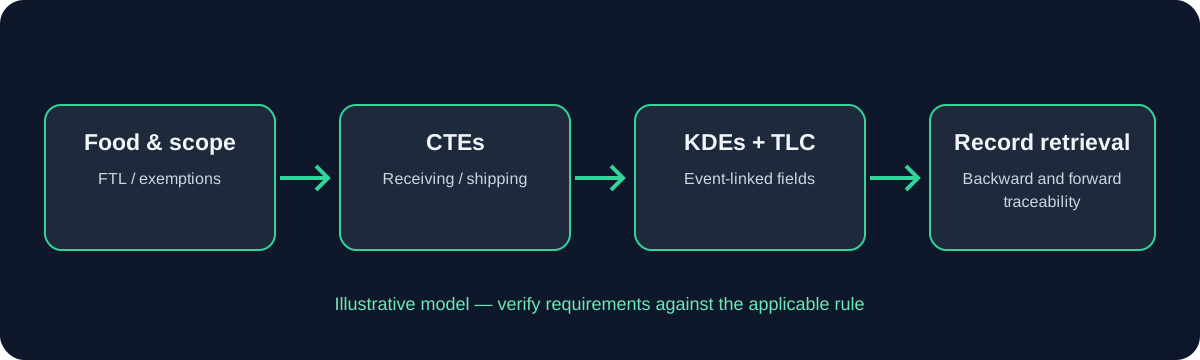
What this guide covers
The TLC is the lot identifier. The TLC Source is the physical location where the code was assigned. A TLC Source Reference may be used only as allowed by the rule. A supplier name alone may not identify a physical location clearly.
Practical implementation
Store the TLC and source information as linked fields. Maintain a controlled location directory and test whether staff can resolve a source reference without relying on informal knowledge.
Limitations and verification
Fictional examples do not establish a required code format or authorize arbitrary references. Verify the exact method and KDEs against the regulation.
How the TLC, TLC source and TLC source reference work together
These fields answer different questions. The Traceability Lot Code (TLC) identifies the traceability lot. The TLC Source identifies the physical location where that TLC was assigned. A TLC Source Reference is a reference that may be used in place of the TLC Source only as permitted by the regulation. Do not treat the source and the reference as interchangeable labels without checking the conditions in Subpart S.
For example, an internal code such as “PACK-07” is useful only if the controlled records allow a user to resolve it to the correct physical location and if its use is permitted for the applicable circumstance. A supplier’s company name may be too broad if it operates several facilities. The reference directory should define the identifier, the physical location it resolves to, the effective dates and the owner responsible for maintaining it.
Keep the source/reference mapping with the lot data and test it from the perspective of a person who did not create the record. Can that person identify the physical location from the value in the record? Does the lookup still work after a facility rename or relocation? Are historical records still interpretable after a reference changes? If the answer depends on a staff member’s memory, the reference system needs stronger documentation.
Do not invent a universal TLC format or assume that any internal location code is acceptable. Check the exact current regulatory conditions for when a source reference may be used and which KDEs apply. The source/reference directory is an implementation control; it does not alter the legal definition.
How to verify this information
Official and supporting sources
Verify important regulatory claims against primary sources. Draft guidance is non-binding.
Educational information only. The regulation and current official guidance control. This page is not legal advice, FDA approval, or a guarantee of compliance.